
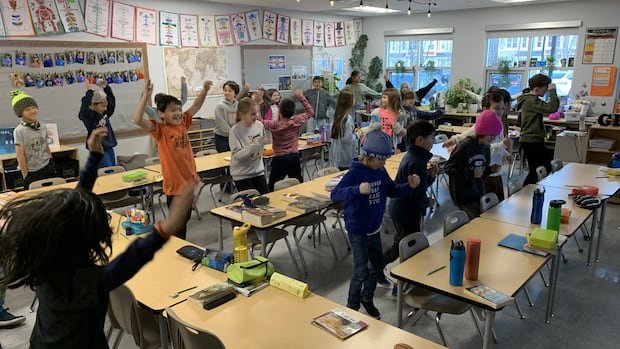

Jacqueline Renfrow expresses relief that her children will soon be back in school following Alberta’s intervention to end the teachers’ strike. However, she finds it bittersweet as the issue of large class sizes, a significant concern during the three-week strike, remains unresolved.
In classes with nearly 30 students, Renfrow’s daughters have struggled to keep up over the past few years due to the lack of personalized attention from teachers who are skilled but often overwhelmed. Renfrow, a regular school volunteer, has resorted to hiring outside tutors, particularly for her nine-year-old, who has faced challenges since starting school during the pandemic.
The issue of large class sizes is not unique to Alberta, as teachers in Ontario and Saskatchewan have also highlighted this problem. The complexity of students in modern classrooms, encompassing diverse needs and backgrounds, has made managing large classes more challenging.
Calls for addressing class sizes persist in education negotiations, with some advocating for caps while others emphasize the need to rethink teaching approaches within classrooms. Teachers and parents in Alberta have voiced concerns about class sizes exceeding 30 or 40 students, impacting individual attention and overall learning experiences.
Education consultant Cathy Montreuil notes that schools are increasingly tasked with addressing various challenges, from mental health issues to food insecurity, alongside the demand for smaller class sizes. While class sizes are a pivotal issue for teachers, Montreuil believes the conversation should extend beyond ratios to focus on enhancing student learning through innovative strategies.
Darryl Hunter, an educational policy studies professor, highlights the impact of class sizes on teacher-student interaction and classroom engagement, emphasizing the need for more personalized learning experiences. He suggests that smaller classes benefit younger students more significantly, particularly in developing foundational skills, while acknowledging the complexity of assessing the impact in high school.
Montreuil emphasizes the importance of implementing effective strategies to support diverse learners and collaboration among educators and support staff. She stresses the need for schools to evolve based on current student needs, rather than solely increasing staffing levels.
Ultimately, the ongoing debate on class sizes reflects divergent views on educational priorities, with educators focusing on student well-being and learning outcomes while governments consider efficiency metrics. The challenge remains in striking a balance between class sizes, teacher support, and innovative teaching practices to meet the evolving needs of students in today’s classrooms.