
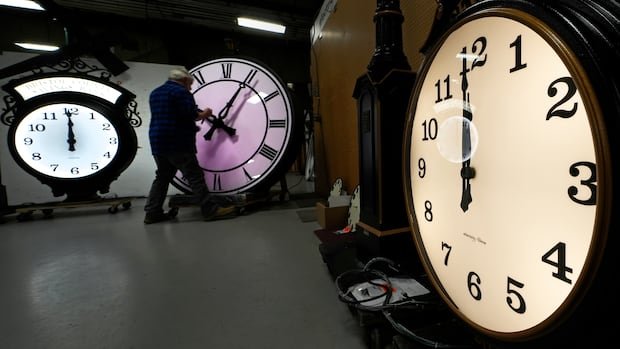

The practice of adjusting clocks with “leap seconds” to match the Earth’s rotation has been in place for over half a century. Recently, a decision was made by a global timekeeping body in France to eliminate leap seconds, allowing clocks to gradually drift out of sync by up to an hour over the course of centuries or even millennia.
The precise atomic time, established in the 1950s by monitoring atomic vibrations, slightly differs from solar time, based on the sun’s position in relation to a specific location on Earth due to the planet’s slowing rotation. Introduced in 1972, leap seconds were used to rectify this discrepancy, with an initial addition of ten seconds.
The International Earth Rotation and Reference Systems Service has since monitored the gap between solar and atomic time to determine when an extra second is necessary. Leap seconds have been added 27 times, most recently in 2016, to maintain accuracy.
If these adjustments were not made, significant time discrepancies could occur over time, potentially resulting in extreme daylight shifts. This method is akin to leap years, where an extra day is added to February every four years to align the Gregorian calendar with the seasons.
However, leap seconds have become increasingly challenging to manage as more systems rely on precise timekeeping. The decision to eliminate leap seconds was made to address the complications they pose for technology and telecommunications companies. Various methods of implementing leap seconds can lead to network inconsistencies, potentially causing system failures.
As the Earth’s rotation has accelerated in recent years, there is speculation about the need for a “negative leap second” in the future. Tech companies have expressed concerns about the impact of such changes on software systems. The International Bureau of Weights and Measures decided to accumulate extra seconds until they reach 3,600, equivalent to an hour, before making adjustments, with the change set to take effect in May 2027.
While some experts support this decision, others, like Paul Delaney from York University, question its implications for our technology-driven society. Despite the challenges in timekeeping, Samantha Lawler, an astronomy professor, emphasizes the imperfection of any system in accounting for Earth’s dynamic changes, suggesting that accepting slight inaccuracies may be necessary.