

The Federal Court of Appeal has ruled in favor of the Liberal government by affirming its classification of plastics as toxic, allowing Ottawa to implement a ban on single-use plastic products.
This ruling is a setback for Canada’s plastics sector, which had contested the federal government’s measures intended to combat plastic pollution.
The unanimous ruling indicated that a previous judge had made an error in deeming Ottawa’s classification of plastic items as toxic to be “unreasonable and unconstitutional.”
The three justices of the appeal court stated that the earlier decision was “based on a flawed assumption” and did not violate provincial or territorial authority.
-
Marketplace
What’s the impact when ‘compostable’ products become litter?
-
Marketplace
Which reusable grocery bags succeeded or failed Marketplace’s durability test?
“There are no constitutional concerns involved,” the ruling declared.
The court also determined that the government’s choice was sensible, as plastics can be harmful to both human health and the environment.
Justice Donald Rennie of the Federal Court of Appeal penned the decision, which was supported by the other two judges on the panel. It served as a strong repudiation of a 2023 Federal Court ruling which Rennie characterized as “a classic case of a court engaging in a ‘line-by-line treasure hunt for error.’
In 2021, the Liberal government designated all plastic-manufactured products as toxic under the Canadian Environmental Protection Act.
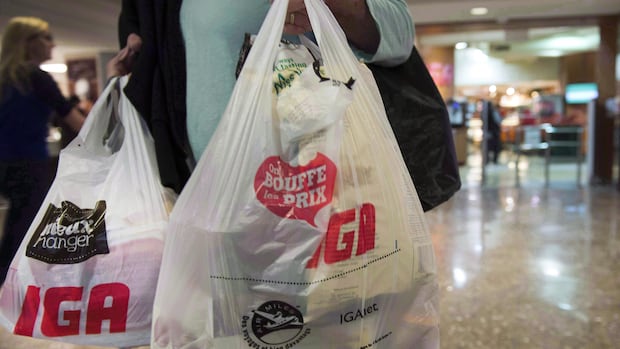
This designation was necessary for the federal environment minister to move forward with regulations to prohibit single-use plastic items nationwide, including plastic shopping bags, utensils, styrofoam containers, stir sticks, and straws.
In 2023, Federal Court Justice Angela Furlanetto overturned that ban. In her ruling, Furlanetto argued that Ottawa’s classification of plastic-manufactured items (PMI) as toxic was overly broad. The judge concluded that the federal government failed to prove that all plastics are harmful to people and the environment and that it overstepped provincial authority.
The Liberal government, under the leadership of then-prime minister Justin Trudeau and former environment minister Steven Guilbeault, promptly appealed. They secured a stay from the Federal Court of Appeal, allowing the ban to remain in effect.
Environment and Climate Change Minister Julie Dabrusin stated that Friday’s ruling ensures the continuation of Canada’s regulations on single-use plastics.
She noted that the decision aligns with her department’s report, which identified plastic pollution as “a significant threat to Canada’s environment” and provides the government with “essential tools to take informed action.”
“Canadians are worried about the health and environmental consequences of plastics, and they expect their governments to act against plastic pollution,” she stated.
-
Lawyer claims court erred in ruling against Ottawa’s classification of plastics as toxic
-
Judge rules Ottawa’s classification of plastic items as toxic was ‘unreasonable and unconstitutional’
-
Ottawa claims industry’s challenge to single-use plastics ban will have no ‘practical effect’
The lawsuit was initiated by significant industrial stakeholders, including Dow Chemical, Imperial Oil, and Nova Chemicals.
The legal struggle may not yet be over, as plastic manufacturers could potentially file a final appeal with the Supreme Court of Canada.
An industry group representing plastic producers, the Responsible Plastic Use Coalition, stated in a statement that it is “assessing the ruling and contemplating legal options.”
The governments of Saskatchewan and Alberta also took part in the case.
“We are disappointed with the decision from the Federal Court of Appeal,” said Ryan Fournier, press secretary for Alberta’s minister of the environment and protected areas. “We are reviewing all avenues to defend our jurisdiction and jobs, including the possibility of an appeal to the Supreme Court of Canada.”
Legal disputes set Canada back: Guilbeault
In an interview with CBC News on Friday, Guilbeault, a strong advocate for addressing plastic pollution through federal regulations, expressed relief at the unanimous ruling but noted that years of legal disputes have hindered progress.
“We had to take a step back and await the Court of Appeal’s decision,” he remarked.

While we know single-use plastics can wreak havoc on the planet, are the so-called “sustainable” alternatives truly better? Marketplace investigates the claims to uncover the truth, revealing how companies have merely swapped one disposable option for another.
David Wright, a law professor at the University of Calgary, remarked that the ruling is “very significant,” especially in the context of growing concerns that governments are weakening environmental protections to expedite major projects.
“This decision will serve as a testament to environmental law’s resilience and the judiciary’s commitment to upholding the law, adhering to scientific evidence, and thoroughly understanding the relevant statutory framework rather than being swayed by changing political climates,” Wright commented.
NDP urges Liberals to take further action
Numerous environmental organizations and legal advocates who have fought for years in court celebrated the outcome.
“We are delighted to see the court adopt a strong and purposeful interpretation of the law that enables Canada to tackle emerging environmental threats and act with precaution,” said Ecojustice lawyer Lindsay Beck, who represented environmental organizations in the litigation.
“Today’s ruling is a significant victory for ocean conservation and for Canadians,” stated Anthony Merante, a senior plastics campaigner with Oceana Canada. “The court has confirmed that science-based measures to mitigate plastic pollution are both legal and essential.”
As the extensive ruling is digested, attention now turns to how the government will utilize the federal authority affirmed by the appeal court to further combat plastic waste.
NDP MP Gord Johns, a proponent of government action against plastic pollution, urged Ottawa to implement “strong, enforceable regulations instead of allowing wealthy corporations to delay necessary action.”
However, Dabrusin did not commit to indicating whether the ruling would compel the government to take additional measures.
“Today I am taking a moment to acknowledge that we have the affirmation we need to proceed with action,” Dabrusin remarked.
Nonetheless, the Canadian Produce Marketing Association, representing fresh produce producers, expressed concerns regarding potential future government actions.
“In light of the current North American and global trade landscape, it is crucial that today’s ruling does not lead to trade disruptions or negatively affect food availability, affordability, and the stability of fresh produce supply chains,” stated association president Ron Lemaire in a statement.
Ellis Ross, the Conservative environment critic, indicated that despite the ruling, his party will continue to oppose plastic bans.
“This court ruling will keep the Liberals’ unscientific ban on plastics imposed upon Canadians, increasing costs for everyone,” Ross stated.