
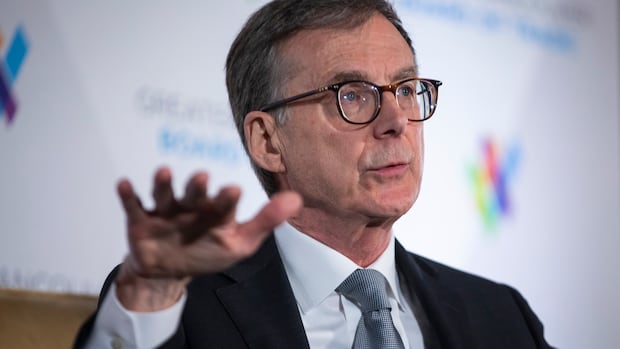

Tiff Macklem, the governor of the Bank of Canada, will conclude his tenure at the central bank when his term ends on June 2, 2027.
In a statement made on Monday, the Bank of Canada announced that Macklem will not pursue a second term after his current seven-year term comes to a close. The central bank indicated that it has initiated the process of finding his replacement and aims to finalize this by the spring.
“During my tenure as governor, Canada has navigated through a world that is increasingly fragmented and prone to shocks,” Macklem, who is 65, remarked on Monday.
“The Bank has responded to these obstacles by making decisive moves, employing sound judgment amid uncertainty, and serving Canadians with humility and a strong commitment to its objectives.”
Macklem’s departure had been anticipated, as it has been over four decades since a governor of the Bank of Canada was reappointed for a second term, with the last instance occurring in 1980.
On Monday, the Bank of Canada disclosed that a search committee has been constituted by its 12 independent board directors to identify the next governor. The Zurich-based recruitment firm Egon Zehnder will assist in this process, according to the announcement.
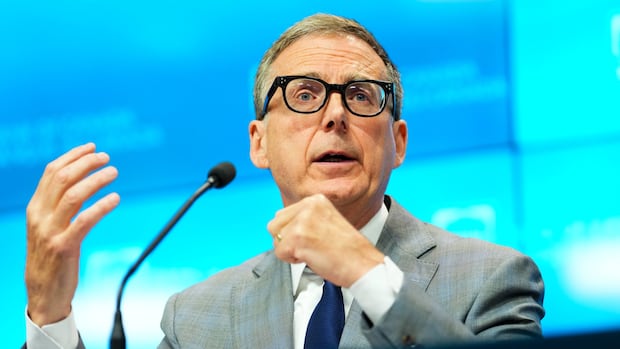
Bank of Canada governor Tiff Macklem, who held rates in October, says the bank needs to see ‘clear evidence’ that core inflation is moving down.
Although the board will technically select the new governor, the ultimate decision will lie with Prime Minister Mark Carney, a former bank governor, and Finance Minister François-Philippe Champagne.
A 14-page specification document outlines that candidates must possess Canadian citizenship, hold a PhD or an equivalent graduate degree in economics, be fluent in both official languages at a high level, and have experience at the highest tiers of central banking, public policy, financial regulation, financial markets, academia, and/or international institutions.
Unprecedented challenges
Macklem’s governorship at the Bank of Canada commenced on June 3, 2020, amidst the initial wave of the COVID-19 pandemic.
Prior to his current role, he served as the dean of the Rotman School of Management at the University of Toronto and was also the senior deputy governor at the Bank of Canada under then-governor Mark Carney.
Throughout his leadership, Macklem encountered extraordinary challenges, including inflation shocks linked to the pandemic and the ongoing trade conflict between Canada and the U.S.
Following a peak inflation rate of 8.1 percent in mid-2022, Macklem implemented one of the most aggressive rate hikes in the central bank’s history, raising the policy rate from 0.25 percent to five percent, which entailed 10 consecutive increases over a span of 16 months.
On Monday, Statistics Canada reported that the annualized consumer price index for October was 3.1 percent. The Bank of Canada aims to maintain inflation at two percent, the midpoint of its target range.
While Macklem appears to have gained better control over runaway inflation, he arguably misjudged the trend in 2021. At that time, he and other leaders, including then-U.S. Federal Reserve chair Jerome Powell, characterized the rising prices as “transitory,” suggesting they were primarily the result of temporary pandemic-related supply chain disruptions that would quickly resolve as the economy reopened.
“In hindsight, we could have likely started retracting stimulus measures sooner,” Macklem reflected during a February 2024 address to the Montreal Council on Foreign Relations.
“Getting monetary policy right is challenging, and we won’t achieve perfection at all times.”
Macklem’s time in office will also be noted for his candid remarks regarding the repercussions of deteriorating trade relations between Canada and the U.S.
For instance, in a speech in February 2025, he cautioned that enduring U.S. tariffs on Canadian imports could lead to a “structural change” resulting in a significant supply shock and reduced demand.
He explained, “This would be akin to the situation at the onset of the pandemic,” addressing members of the Mississauga Board of Trade and the Oakville Chamber of Commerce. “However, unlike the recovery that followed the pandemic crisis, this time there will be no rebound.”