


Although the Cold War officially concluded many years ago, recent studies indicate that its effects have persisted in the plant life of Gatineau Park.
For 65 years, researchers have been gathering maple leaves from this vast western Quebec park to search for evidence of nuclear radiation.
Research spearheaded by Len Wassenaar reveals that, up until 2024, these leaves contained remnants of radiocarbon from the early Cold War period, as detailed in a study published in the journal Nature Scientific Reports.
Wassenaar serves as the executive director of the André E. Lalonde National Facility for Accelerator Mass Spectrometry at the University of Ottawa.
He appeared on CBC Radio’s Ottawa Morning last week to discuss his findings.
The following interview has been edited for brevity and clarity.

Len Wassenaar states that until 2024, the park’s maple leaves contained traces from nuclear testing over 60 years ago. He is the executive director of the André E. Lalonde National Facility for Accelerator Mass Spectrometry.
Can you explain what you’re investigating regarding the leaves in Gatineau Park?
The investigation traces back to the 1960s, when there was significant concern among scientists about global nuclear fallout stemming from the arms race and hydrogen bomb tests.
In 1961, the Geological Survey of Canada began collecting sugar maple leaves in Gatineau Park to study the impacts of atmospheric nuclear testing.
What findings did the leaves reveal?
Essentially, the nuclear detonations from the 1950s and 60s released substantial amounts of radioactive carbon-14 into the atmosphere.
You might recall the iconic images of mushroom clouds from these explosions. The carbon reacted to form carbon dioxide, which dispersed rapidly worldwide.
These bomb tests effectively doubled the radiocarbon levels in the atmosphere, peaking around 1964. Trees absorbed this radiocarbon through their leaves via CO2.
While nuclear testing largely ceased by 1980, this radiocarbon signature has persisted, officially concluding in May 2024 in the Ottawa area.

Visitors capture photographs amid the autumn colors at Pink Lake in Gatineau Park during Thanksgiving on Monday, October 12, 2026. (Keito Newman/The Canadian Press)
So, was there no longer any evidence of it by then?
Correct. Two major factors contributed to this.
Firstly, the carbon dioxide that contained bomb-related radiocarbon was absorbed by plants and oceans, effectively removing it from the atmosphere.
Secondly, the ongoing combustion of fossil fuels has no radiocarbon, which has diluted the concentration of bomb-related carbon in the atmosphere.
These combined effects have essentially brought radiocarbon levels back to what we would consider pre-bomb conditions. Currently, the impact of fossil fuel combustion continues to be observed, which is expected to persist in the future.
Is it a positive development that these radioactive traces are no longer found in the leaves?
Yes, it is. This finding highlights the long-lasting consequences that nuclear activities can impose over decades.
It’s important to note that the levels of radiocarbon detected are extremely low, presenting no health risks to humans. These are trace amounts measured in parts per trillion, which are negligibly small.
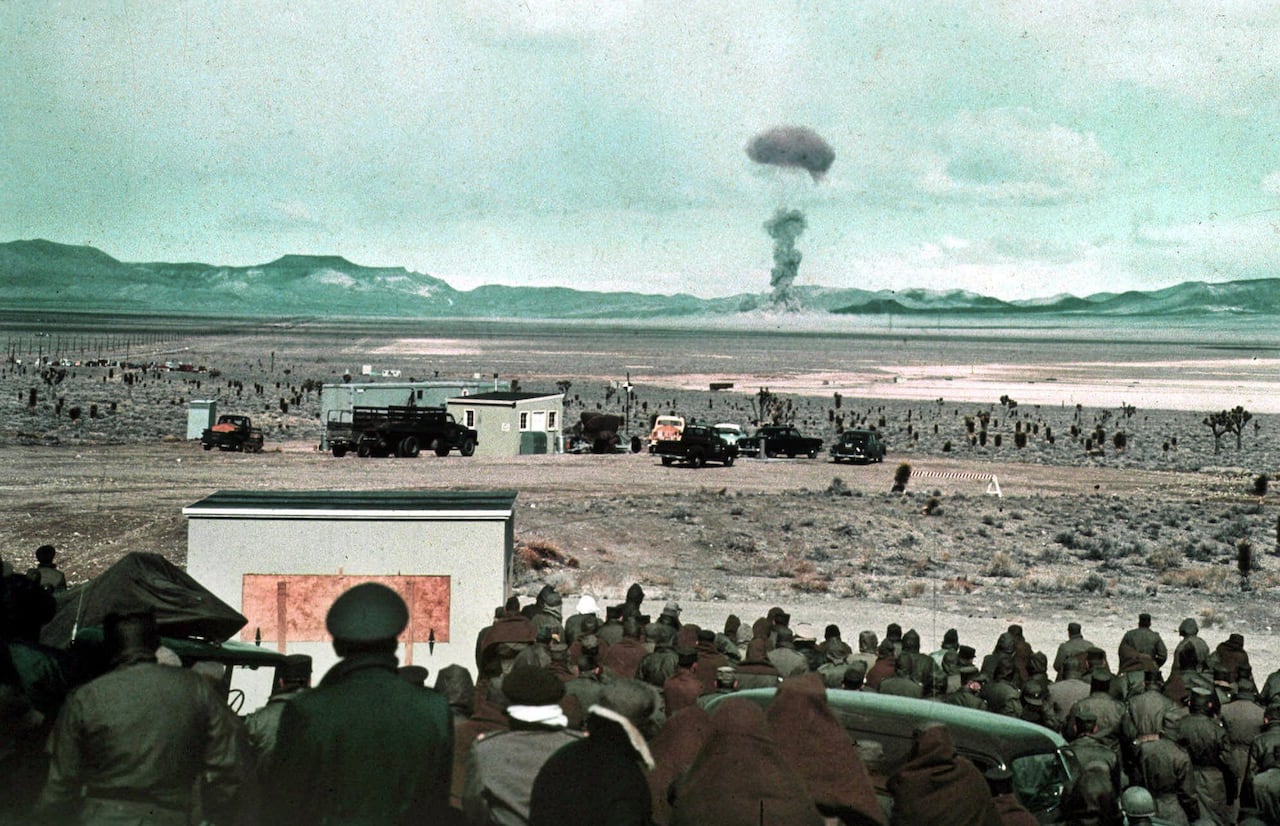
Military personnel observe a mushroom cloud rising from the Met test, a 22-kiloton explosion that took place on April 15, 1955, at the Nevada Test Site, northwest of Las Vegas. (Associated Press)
In what ways could these findings be beneficial on a larger scale?
Primarily, it underscores the enduring legacy of nuclear testing, which can be detected even 40 to 50 years later.
It also demonstrates the value of long-term scientific research, as it took 65 years to observe the conclusion of this radiocarbon presence.
As we continue to rely on fossil fuels, if we were to decrease or eliminate their use, we could see a reversal of this trend. This serves as an excellent illustration of how nature can document environmental impacts over extended periods, which we must heed.