
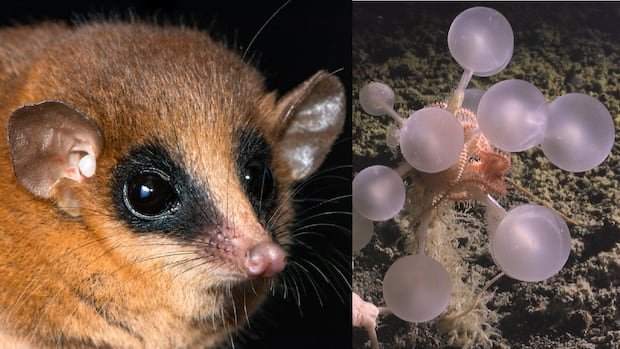

A spider boasting unusually long genitalia for strategic mating, a carnivorous caterpillar incorporating prey body parts into its cocoon, and a diminutive mountain-dwelling opossum are among the fascinating newly discovered species unveiled by scientific research in 2025.
A recent study revealed that approximately 16,000 novel species are identified annually, with the rate of discovery notably accelerating. Over the past two decades, 15 percent of all known species have been newly documented. John Wiens, an ecology professor at the University of Arizona and co-author of the study, emphasized that the discovery rate surpasses the rate of species extinctions, estimated at around 10 per year.
While many of these species were previously known or documented locally, their formal identification and description by the scientific community are crucial steps. Wiens emphasized the significance of this process, stating, “We can’t protect a species from extinction if we are unaware of its existence.”
Delving into the specifics of some of these intriguing species, four distinct tarantula species were unearthed in the Horn of Africa and Arabian Peninsula. Notably, the males of these tarantulas possess the lengthiest genitalia among all known tarantulas. For instance, the largest species named Satyrex ferox boasts a leg-span of 14 centimeters, with males sporting palps measuring five centimeters in length, nearly rivaling the length of their longest legs.
In a separate discovery, researchers in Hawaii found a unique caterpillar species known as the “bone collector,” which resides in spider webs, consumes trapped prey, and adorns its cocoon with the body parts of its victims. This distinct caterpillar morphs into a moth with feathery wings and is only found in a limited forested area in Hawaii, hinting at its vulnerable status.
Venturing into the depths of the ocean, a recent expedition near Antarctica led to the identification of 30 new species, including the carnivorous “death-ball” sponge, equipped with spheres covered in tiny hooks to ensnare prey. The list of discoveries also includes new sea stars and an armored, iridescent scale worm.
In shallower waters, a striking sea slug resembling fried eggs named Phyllidia ovata was uncovered in Indonesia. This visually appealing slug preys on sponges and defensively borrows their toxins. The species, previously spotted by divers, was formally described in July.
Furthermore, a new aquatic species, the Okanagan crayfish, was identified in British Columbia’s Okanagan Lake, distinct from the common signal crayfish due to the absence of a characteristic white mark on its claw. Regrettably, this species is deemed endangered, raising concerns given the heavy human activity in Okanagan Lake.
Canadian researchers played a pivotal role in discovering six new tube-nosed bat species in the Philippines. These bats, weighing between four and 14 grams, were collected over three decades in various expeditions, highlighting the ongoing exploration and revelation of diverse species.
Lastly, a small mouse opossum, Marmosa chachapoya, inhabiting the Peruvian Andes, stood out for its unique features and high-altitude habitat. This mouse-sized marsupial, described in June, offers a glimpse into the diverse and intriguing world of newly discovered species in 2025.
Amidst these remarkable discoveries, toads in Tanzania showcased a peculiar reproductive strategy, giving birth to live toadlets due to their arboreal lifestyle far from water sources. This live-bearing phenomenon, rare among frogs and toads, underscores the exceptional nature of these recently identified species.
As the realm of scientific exploration continues to unveil the mysteries of the natural world, each new species discovery serves as a testament to the vast biodiversity and ecological wonders awaiting exploration and conservation.