
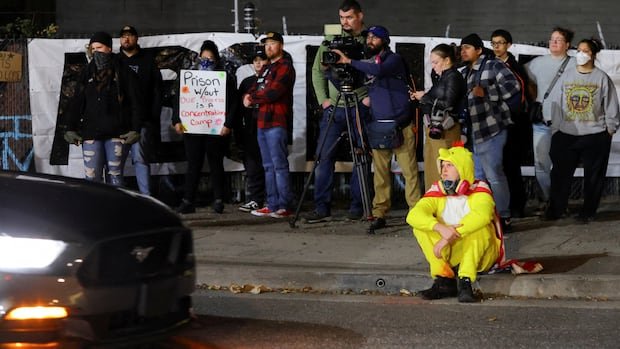

The debate surrounding the deployment of the National Guard in U.S. cities has escalated and is now a subject of legal battles in American courts. Governors in Oregon and Illinois are challenging President Donald Trump’s administration’s efforts to send troops to their states.
President Trump has labeled Portland as “war ravaged” and facing attacks from Antifa and other domestic terrorists, leading to his decision to dispatch National Guard troops to the city. However, this move was promptly contested in court by the Oregon governor, resulting in a judge halting the military deployment temporarily.
In a similar vein, Trump directed up to 300 members of the Illinois National Guard (along with 400 from Texas) to Chicago against the objections of Governor J.B. Pritzker. Local leaders and residents in both cities have refuted claims of lawlessness and labeled the characterization of their cities as war zones as unfounded.
The legal battle and the ground reality in these cities have drawn significant attention amid the ongoing tensions. The State of Oregon took legal action against the Trump administration, arguing that the U.S. Constitution permits domestic military deployment only under extreme circumstances like foreign invasion or insurrection.
U.S. District Judge Karin Immergut sided with Oregon, issuing a ruling that temporarily blocked the deployment, citing the lack of justification for federalized forces in response to relatively minor protests in the city. Despite this, the administration redirected National Guard troops from California to Portland, prompting further legal challenges.
In a parallel development, Trump’s decision to send troops to Chicago was met with strong opposition from Governor Pritzker, who denounced the move as “outrageous and un-American.” Illinois filed a lawsuit against the deployment, alleging political motivations behind Trump’s actions.
The situation on the ground in Chicago witnessed ICE agents conducting aggressive operations, including storming an apartment complex by helicopter, deploying chemical agents near a school, and apprehending a City Council member at a hospital. Civil rights activists accused federal agents of using excessive force against peaceful protesters and journalists, leading to heightened tensions.
The roots of these events can be traced back to persistent protests at ICE facilities in Portland, which escalated over the summer with clashes between protesters and federal officers. Trump’s consideration of federal intervention was triggered by these protests, culminating in the deployment of National Guard troops to address the perceived unrest in the cities.
The unfolding legal battles and the actions on the ground have sparked debates on the limits of federal intervention in domestic affairs. While the current order barring troops from Oregon is temporary, efforts are underway to extend the restriction. However, the Trump administration remains steadfast in its stance and plans to appeal the court decisions, highlighting the ongoing discord between federal and state authorities.