
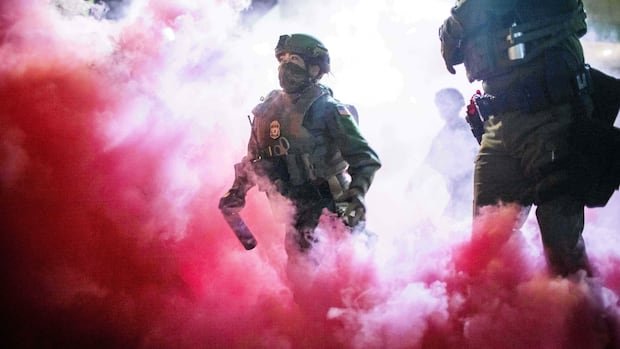

Illinois took legal action on Monday to prevent President Donald Trump from deploying National Guard troops to Chicago, marking an escalation in the conflict between Democratic-led states and the Republican administration during an intense immigration enforcement operation in the nation’s third-largest city. The move came shortly after a judge in Portland, Oregon, halted the Guard’s deployment on Sunday.
The Trump administration has characterized the targeted cities as war-torn and lawless in the midst of the government’s crackdown on illegal immigration. Officials in Illinois and Oregon have opposed military intervention, arguing that federal involvement is exacerbating the situation.
The lawsuit filed by Illinois contends that the deployment is both “unlawful and dangerous.” A federal judge has granted the Trump administration two days to respond to the lawsuit from Illinois, while refraining from an immediate block on the deployment.
Judge April Perry in Chicago has set a deadline for Wednesday midnight for the federal government’s response and scheduled a hearing on Thursday for the lawsuit filed on Monday. Despite this, according to a presidential memo on Monday evening, Trump proceeded with activating 300 members of the Illinois National Guard.
Illinois Governor J.B. Pritzker, a Democrat, expressed concerns that around 300 guard troops from the state would be federalized and dispatched to Chicago, along with another 400 from Texas. The lawsuit emphasized that citizens should not live under the threat of military occupation simply due to disagreements with the president.
President Trump mentioned on Monday his willingness to bypass Governor Pritzker and potentially invoke the Insurrection Act if needed. The Act, dating back to 1807, empowers the president to deploy active-duty military in states facing insurrection or defiance of federal law under specific circumstances.
In response to the potential deployment, Governor Pritzker labeled it as “Trump’s invasion” and urged Republican Governor Greg Abbott of Texas to intervene. Mayor Brandon Johnson of Chicago issued an executive order prohibiting federal immigration agents from using city-owned properties for enforcement operations.
Moreover, the ACLU of Illinois filed a lawsuit against Trump, ICE, the Department of Homeland Security, and others, alleging a campaign of violence and intimidation against peaceful protesters and journalists. The lawsuit cited the use of force, including tear gas and rubber bullets, as interfering with First Amendment rights.
In Oregon, U.S. District Judge Karin Immergut granted a temporary restraining order requested by Oregon and California to prevent the deployment of guard troops to Portland. The White House has declared intentions to appeal the ruling, asserting confidence in the president’s legal authority for such actions.
Local officials have refuted some of the president’s assertions about Portland, indicating a reduction in crime rates and a decrease in disruptive protests compared to 2020. Trump’s deployment or proposed deployment of troops to various cities has sparked legal challenges and debates over federal authority in local law enforcement matters.