
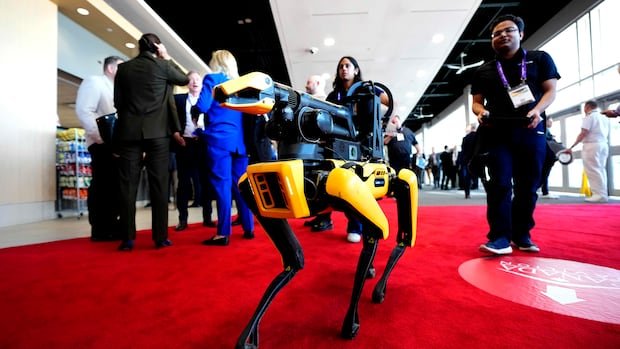

A global competition is currently in progress to integrate robotics into our daily routines, with a new wave of AI-driven robots offering increased flexibility. The rapid progress in artificial intelligence has led to robots being utilized for various tasks, from collaborating with humans in warehouses to transporting packages on urban streets and inspecting hazardous areas.
The concept of “physical AI” is now a prevalent term in artificial intelligence, as showcased at the recent Consumer Electronics Show (CES). This approach involves equipping physical systems, such as robots, autonomous vehicles, or industrial machinery, with sensors to enable logical and responsive actions in conjunction with current AI methodologies.
During CES, Google and the American robotics firm Boston Dynamics unveiled a partnership to trial AI-powered robots in Hyundai auto plants, incorporating two versions of a robot called Atlas. Although the development of general-purpose humanoid robots for household chores like dishwashing and laundry folding is still a distant goal, the integration of AI into physical applications is rapidly progressing.
Traditional robot programming involves a top-down approach for executing specific sequences of actions, suitable for controlled environments with repetitive tasks. However, leveraging generative AI techniques allows for a bottom-up training approach, making robots more adaptable and capable of learning while performing tasks.
This evolution enables robots to adjust swiftly and handle more complex assignments by enhancing their reasoning and decision-making capabilities. For instance, autonomous vehicles can be trained in virtual environments for safe navigation. Companies like Waabi have developed realistic simulators to train self-driving vehicles effectively.
Despite the advancements in robotics technology, experts suggest that Canada is falling behind in embracing these innovations. China has emerged as a global leader in robotics, with a significant portion of industrial robots worldwide installed in the country. China’s shift from importing robots to manufacturing them domestically is propelling its progress ahead of other nations.
The global robotics market witnessed substantial growth, reaching nearly $50 billion in 2025 and projected to soar to $111 billion by 2030. In contrast, Canada’s industrial robotics adoption is lagging, ranking 13th in operational stock in 2024. The automotive sector is a notable exception in Canada’s robotics adoption landscape, where the country exhibits strong adoption rates.
Canadian companies encounter challenges in marketing robotics domestically, often needing to explore international markets for growth. Regulatory constraints and a lack of familiarity with robotics impede adoption in Canada. A national robotics strategy may help address these issues and boost Canada’s competitiveness in the robotics sector.
While Canada’s AI strategy is under development, industry experts emphasize the need for a comprehensive national robotics strategy to harness the transformative potential of robotics technologies. Countries like China, South Korea, Germany, and Japan have established dedicated national strategies focusing on training, incentives, and funding to drive robotics innovation and adoption.