
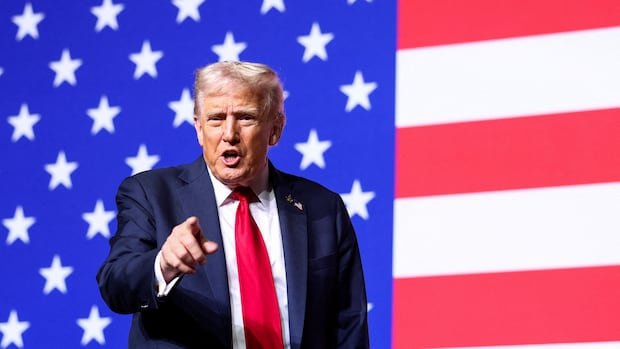

U.S. President Donald Trump has raised the possibility of invoking the Insurrection Act, a move not used by a U.S. president for over thirty years. Trump has shown interest in deploying the military to various U.S. cities, predominantly under Democratic leadership, to address what he and his administration perceive as escalating crime levels.
Legal disputes are unfolding between the Trump administration and officials in Illinois, California, and Oregon, who have not requested federal intervention. Nevertheless, the president has hinted at a more assertive approach to implementing this measure. “If I had to do it, I would,” he stated on Monday, emphasizing the importance of ensuring public safety and preventing loss of life.
The Insurrection Act grants the U.S. president authority to mobilize the military or federalize National Guard troops to suppress uprisings and rebellions. While commonly known as the Insurrection Act of 1807, experts like Stephen Vladeck have highlighted that the involvement of the military in domestic law enforcement is governed by a series of statutes dating back to the late 18th century.
In situations where the Insurrection Act is invoked, troops can conduct searches and arrests, potentially overriding the limitations outlined in the Posse Comitatus Act of 1878, which restricts the military’s involvement in law enforcement activities primarily handled by local authorities.
During past incidents of deploying the National Guard, such as in Los Angeles, Trump relied on a different legal basis, Section 12406 of Title 10 of the U.S. Code, which prohibits the National Guard from engaging in civilian law enforcement activities like making arrests.
The potential use of the Insurrection Act has stirred controversy due to the historical American tradition of separating federal military involvement from civilian matters. Critics argue that the vague language in some statutes, like Section 253 of the Insurrection Act, could lead to broad interpretations that may infringe on civil liberties and constitutional rights.
In response to the current situation, state officials have expressed opposition to the federal military intervention. Illinois Governor J.B. Pritzker criticized the Trump administration’s actions, accusing them of attempting to depict peaceful protesters as a violent mob to justify invoking the Insurrection Act.
While the U.S. faces challenges with violent crime rates in cities, recent statistics show a decline in per-capita homicide rates, with some cities reporting the lowest numbers in decades. Despite this, concerns remain over the potential repercussions of deploying federal troops under the Insurrection Act.
The Insurrection Act has been utilized approximately 30 times throughout history, with the most recent instance occurring in 1992 when George H.W. Bush responded to a request from the Governor of California following riots in Los Angeles. Previous administrations have invoked this act during times of civil unrest to protect citizens and uphold law and order.
Legal experts note that while the president has the authority to deploy the military under the Insurrection Act, the Supreme Court could intervene if such actions are deemed unauthorized or conducted in bad faith. However, recent court decisions have shown a tendency to grant significant discretion to the president in matters of national security and law enforcement.