
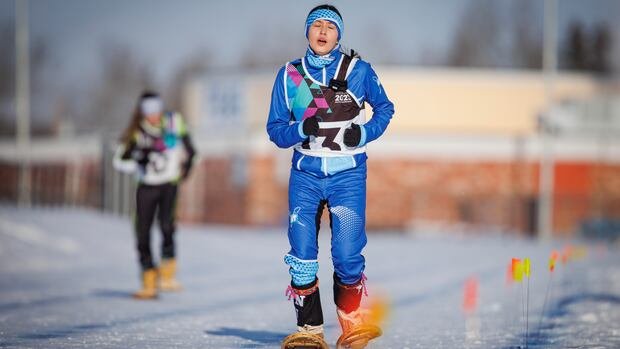

The team representing the Northwest Territories at the Arctic Winter Games will not be participating in snowshoe races next year.
Bill Othmer, the executive director of Sport North, confirmed the decision, which was initially reported by Cabin Radio.
According to Othmer, the N.W.T. Multi-Sport Games Committee made the call.
Comprising members from the Department of Municipal and Community Affairs (MACA), Sport North Federation, and the Indigenous Sports Circle of the N.W.T., the committee reached this decision.
The upcoming Arctic Winter Games are scheduled to take place in Whitehorse from March 8-15 next year.
The snowshoe competition includes four events: long distance, short/middle distance, relay, and a combined event with three shorter distances on a track, as outlined on the event’s website.
Despite this change, the N.W.T. will continue to participate in snowshoe biathlon.
Explaining the rationale behind cutting snowshoeing, a spokesperson from MACA cited capacity constraints.
The Arctic Winter Games International Committee limits the territory to 363 participants, with 355 being sport-related positions and eight cultural-related positions.
The statement highlighted that the introduction of SafeSport policies in 2020 led to increased adult supervision and support roles, creating pressures on team composition.
For the 2026 games, there was an excess of interested participants exceeding the committee’s limit by 21, necessitating cuts. The reductions include:
-
10 snowshoeing positions (the entire team).
-
Two biathlon ski positions.
-
Two biathlon snowshoe positions.
-
Five wrestling positions.
-
Two mission staff roles.
The decision to eliminate snowshoeing was based on several factors:
-
Absence of a recognized governing body, organization, or club for snowshoeing in the N.W.T.
-
Inadequate sport integrity policies to ensure player safety.
-
Lack of sanctioned competitions or athlete development pathways.
-
Past participation and performance records.
Before finalizing the decision, consultations were conducted with the Indigenous Sports Circle of the N.W.T., according to the territory.
Former coach, competitor expresses disappointment
The statement noted that broader engagement with Indigenous leaders outside of the sport governance structure did not occur, as the allocation process prioritizes sport readiness, governance, and safety standards.
Nevertheless, the GNWT affirms its commitment to enhancing transparency and inclusivity in future games planning.
Victor Marie, a former snowshoeing competitor and coach at the Arctic Winter Games, expressed his disappointment upon learning about the sport’s exclusion.
Marie, who had contemplated coaching in the upcoming games, felt disheartened by the news.
He reflected on the significance of snowshoeing to Indigenous communities, both within and beyond the games, questioning why it was removed while non-Indigenous sports like badminton and basketball were retained.
“Snowshoeing should be the last sport to be cut,” Marie emphasized.