
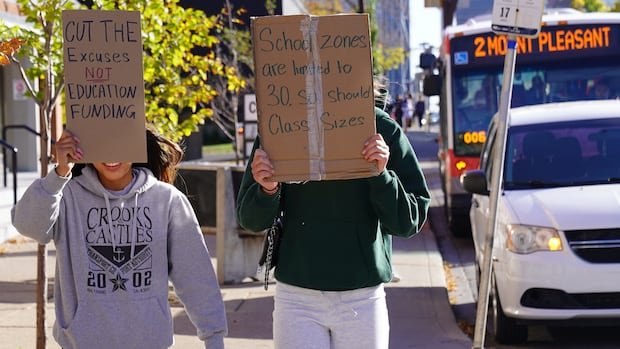

One of the main concerns in the ongoing strike by teachers in Alberta revolves around class sizes, which have expanded significantly. The exact size of classes is challenging to determine as the province no longer collects specific data on this matter.
Previously, Alberta used to release annual reports on class sizes, providing detailed information on the number of students in each class at over 1,500 schools across the province.
In 2019, the newly elected UCP government decided to discontinue this practice.
Subsequently, the government altered the funding formula for school boards, transitioning from annual enrollment-based funding growth to a three-year “weighted moving average” (WMA) model, which has been heavily criticized by larger school boards in rapidly growing urban areas.
The change came into effect in September 2020 during the COVID-19 pandemic, leading to a brief enrollment decline followed by a surge. However, due to the formula’s reliance on previous years’ enrollment figures, many school boards received less funding under the new model.
Concerns regarding the impact of the formula persist, with some school boards experiencing funding shortfalls and increased class sizes.
The Alberta government ceased collecting data on class sizes the year before implementing the new formula, making it challenging to quantify the effect on class sizes. However, analyzing the growth of teaching staff compared to student enrollment since the formula change provides some insight into the situation.
Examining the Data
The provincial government includes information on the number of “certificated staff” in its annual budget documents, offering a broad perspective on the teaching workforce. While not a perfect measure, it indicates how teaching staff growth aligns with student enrollment at a provincial level.
A gap has emerged between the growth rates of teaching staff and student enrollment since around 2021, with enrollment outpacing staffing increases.
This gap has persisted up to the end of the 2025 school year, the most recent year for which enrollment figures are available. Overall, student enrollment has increased by 15% since 2016-17, while teaching staff growth has been 8%.
Darryl Hunter, an educational policy studies professor at the University of Alberta, warns that while the correlation is evident, it does not prove causation.
School board officials have linked the WMA formula directly to larger class sizes and funding deficiencies in the past.
Recently, the Alberta government introduced a new two-year weighted average funding formula for the 2025-26 school year to address some concerns raised by school boards.
Further Changes in Formula
The new formula focuses on the current year and projected enrollment for the following year, aiming to provide more responsive funding to metropolitan areas while supporting rural schools.
Education Minister Demetrios Nicolaides emphasized that the approach adopted since 2020 offers more flexible funding to school boards, allowing them to make staffing decisions based on specific school needs without mandating class size reporting.
The government views this change as a positive step, acknowledging the challenges faced by crowded classrooms and limited resources.
Additionally, the 2025-26 budget includes the hiring of approximately 1,045 new full-time-equivalent teaching staff, representing a 2.7% increase over the previous year.
The Alberta Teachers’ Association advocates for additional measures to address the shortage of teachers in the province, citing a report from 2003 that recommended hiring over 5,000 new teachers to meet pupil-teacher ratios.
While detailed class-size reporting was discontinued in 2019, some school divisions, like Edmonton Public Schools, continue to monitor this data, indicating that many classes exceed recommended sizes.
Education experts and stakeholders emphasize the importance of transparency and data in understanding student-teacher ratios and their impact on academic success.