
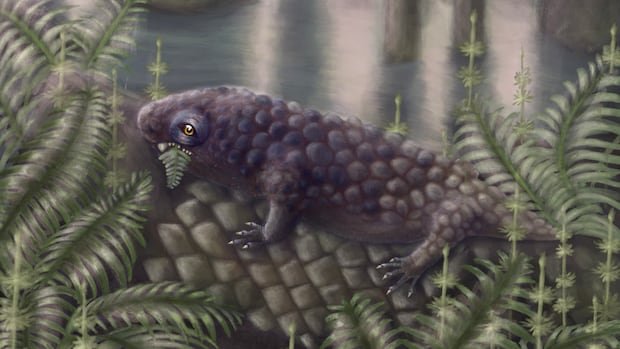

A recently discovered creature the size of a football, capable of grinding its teeth like a hardcore plant-eater in an era when such behavior was uncommon, is believed to be the earliest known herbivorous vertebrate. Named Tyrannoroter heberti, this animal lived approximately 315 million years ago in a dense, fern-covered swamp on present-day Cape Breton Island in Nova Scotia during the late Carboniferous Period.
According to a recent study published in Nature Ecology and Evolution, Tyrannoroter heberti is considered the earliest four-legged animal with teeth suitable for a plant-based diet. This finding challenges previous assumptions about the speed of this dietary transition, as stated by lead author Arjan Mann.
Belonging to the group of small, lizard-like creatures known as microsaurs, Tyrannoroter had a skull that was part of several animal fossils entangled in the roots of a massive, ancient petrified tree stump on Cape Breton Island. Award-winning amateur paleontologist Brian Hebert, who discovered the stump around nine years ago, was honored by having the species name heberti dedicated to him.
The skull of Tyrannoroter resembled that of pantylids, a group of microsaurs with short, squat bodies adapted for digging. Researchers estimate that Tyrannoroter was relatively large, about the size of a football, compared to most pantylids. Its unique feature was multiple rows of “Hershey-kiss” shaped teeth designed for consuming shoots, leaves, and fibrous plant material.
The teeth of Tyrannoroter were advanced for its time, with additional rows or “batteries” providing the necessary surface area for grinding plant matter. This adaptation is comparable to the flat molars found in humans who consume vegetables. The transition to herbivory in tetrapods, which began moving onto land around 375 million years ago, required the evolution of teeth capable of chewing plant material and the development of digestive systems to process cellulose.
The study suggests that early herbivorous animals like Tyrannoroter may have acquired cellulose-digesting abilities by consuming insects. The presence of cellulose-digesting microbes in the guts of pantylids could explain their wide, squat bodies. Understanding the emergence of herbivores is crucial for evolutionary studies, as herbivores play a significant role in shaping plant ecosystems.
While the exact dietary habits of Tyrannoroter are still being investigated, the possibility that it was an herbivore opens new avenues for exploring the evolution of plant-eating behavior in early tetrapods. The findings in this study contribute valuable insights to the field of paleontology and expand our understanding of the ancient ecosystems that shaped the development of herbivorous animals.