

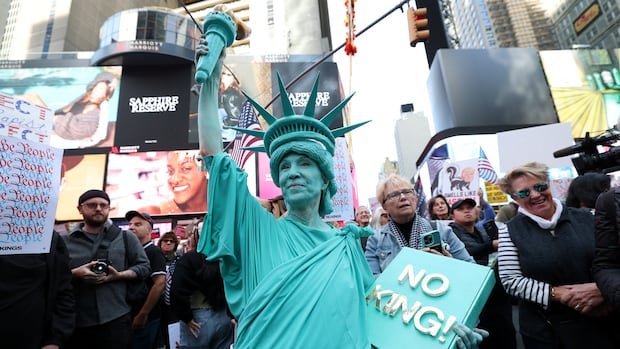
Thousands of individuals assembled in Washington, D.C., and various regions across the United States on Saturday to protest against the current trajectory of the country under President Donald Trump, participating in “No Kings” demonstrations — a term that the president’s Republican Party has dubbed as “Hate America” rallies.
This marked the third significant mobilization since Trump’s re-election in January, occurring amidst a government shutdown that has led to the closure of federal services and programs. The shutdown is seen as a test of the constitutional checks and balances as an assertive executive branch clashes with Congress and the judiciary, sparking concerns among organizers about a potential shift towards authoritarianism in the U.S.
Many protesters expressed frustration over criticisms of their intentions. For instance, in Bethesda, Md., a demonstrator held a sign proclaiming, “Nothing is more patriotic than protesting.”
In a similar vein, Brian Reymann in Washington, D.C., carried a large American flag and condemned the derogatory labeling of protesters as terrorists by Republicans, deeming it “pathetic.” He emphasized his belief that despite political disagreements, all Americans share a love for their country, and any insinuations otherwise are misguided and power-driven.
Meanwhile, President Trump, currently in Florida at his Mar-a-Lago estate, responded to the protests, denying claims of being a king. He characterized the rallies as “Hate America” gatherings and attended a fundraising event for the MAGA Inc. super PAC before the protests.
Over 2,600 rallies were scheduled on Saturday across cities, organized by numerous coalition partners. Unlike previous demonstrations earlier this year, which targeted Elon Musk’s policies and military parades, organizers noted a growing unified opposition movement during this protest.
Prominent figures like Senate Minority Leader Chuck Schumer and Independent Sen. Bernie Sanders joined the rallies as a countermeasure to what they perceive as authoritarian actions by the Trump administration, including restrictions on free speech and aggressive immigration tactics.
The protests extended globally, with solidarity events in various cities, including Montreal, Canada. Attendees expressed solidarity with American democracy and resistance against Trump’s alleged calls for Canada to integrate as a U.S. state.
Republicans criticized the rallies as divisive and outside the mainstream, attributing them to the ongoing government shutdown. Speaker of the House Mike Johnson labeled the protests as “Hate America” rallies, with accusations of communist and Marxist influences.
Democrats, on the other hand, have resisted voting on government reopening until health care funding is secured, aiming to challenge Trump and restore the balance of power in the U.S. system. This marks a significant shift from the past, where Democrats faced internal divisions and uncertainty in responding to Trump’s presidency.
The recent protests signify a growing resistance against perceived authoritarian tendencies, with Democrats and their allies showing a renewed determination to oppose Trump’s policies and assert their democratic values.
Share
Read more