
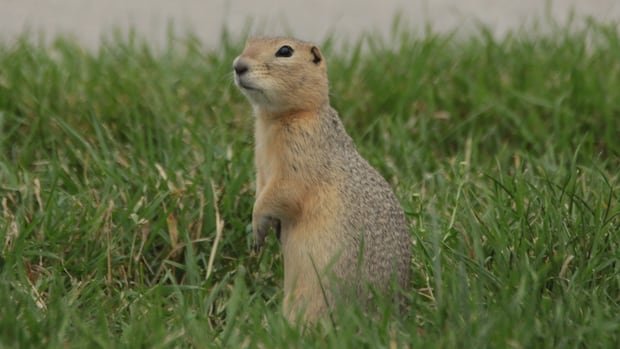

While many find them adorable with their chubby cheeks and playful antics, gophers, also known as Richardson’s ground squirrels, are a nuisance to farmers, causing significant financial losses by damaging crops and equipment with their burrowing activities.
In response to the ban on using strychnine for gopher control due to its adverse effects on wildlife and inhumane nature, the Saskatchewan Wildlife Federation (SWF) introduced a free gopher control program in 2024 to assist farmers.
Executive director Todd Smith mentioned that the initiative stemmed from increased requests for gopher control over the past few years.

Under the program, farmers can reach out to SWF to take advantage of the assistance offered.
Smith explained the process, stating that once farmers provide their details, SWF forwards the information to the nearest branch within the province, where designated volunteers are ready to help.
Volunteer hunters, who are members of SWF, operate under a $5 million liability insurance coverage to ensure responsible and ethical gopher control practices.
While acknowledging the positive aspect of the program, James Husband, reeve of the Rural Municipality of Hazelwood, highlighted the challenge of gopher overpopulation and the program’s limitations in addressing the root problem.
Edmond Sanganyado, an associate professor at the University of Saskatchewan, suggested that shooting gophers could be a more humane alternative to poisoning, citing quicker and more controlled outcomes.
Contrary to the former use of strychnine, which could reach gophers in their burrows, some farmers like Don Connick have turned to zinc phosphide as an alternative method, acknowledging its drawbacks compared to strychnine in terms of effectiveness and cost.
According to Smith, it is crucial to target adult male gophers emerging from mid-February to early March before females follow in mid-March to prevent a further increase in their population.
By acting before the gophers give birth to kits, farmers can mitigate potential crop damage and protect their livelihoods.