
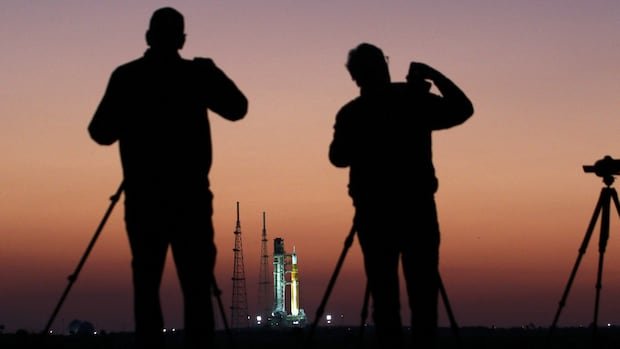

Artemis II is gearing up for its upcoming journey around the moon and back, marking a historic mission that could propel humans further into space than ever before. The expedition will feature four crew members, including Canadian Space Agency astronaut Jeremy Hansen and NASA astronauts Reid Wiseman, Victor Glover, and Christina Koch. They will embark on this mission aboard the Space Launch System (SLS) rocket and the Orion spacecraft, lifting off from Launch Pad 39B at Kennedy Space Center in Florida.
The exact launch timing for Artemis II has been a bit uncertain due to various factors such as risks and system checks. Previous launch attempts in February and March were postponed due to hydrogen and helium issues, alongside weather considerations. However, NASA is optimistic about an 80% chance of a successful launch on April 1.
To achieve the appropriate orbital path to the moon and back, the launch is scheduled at night, with the first attempt set for Wednesday, April 1, between 6:24 p.m. and 8:24 p.m. ET. Subsequent launch opportunities will be available nightly from Thursday, April 2, to Monday, April 6, in case of any delays or cancellations.
For those interested in witnessing the Artemis II launch firsthand, email your plans to ask@cbc.ca. NASA also offers a detailed breakdown of the countdown minutes leading up to liftoff.
Stay informed about the mission’s progress through CBC’s comprehensive coverage led by Science reporter Nicole Mortillaro and reporters Paul Hunter and Karen Pauls. The coverage will include live updates, reactions, and mission highlights across radio, TV, and digital platforms. Detailed online coverage will commence two hours before the launch on CBCNews.ca, featuring a live stream of the event and minute-by-minute updates.
As Artemis II sets its sights on the moon without landing, the mission serves as a critical test for onboard systems with astronauts aboard. Originally planned as a precursor to Artemis III’s lunar landing in 2028, NASA recently reshuffled its Artemis mission timeline, with Artemis IV now slated for a lunar surface landing in 2028.
The Artemis missions aim to establish a sustained presence, conduct scientific research, and promote economic activities on the moon, laying the groundwork for future missions to Mars. NASA’s drive to accelerate space exploration, including plans for a moon base and bypassing the Lunar Gateway spaceport, underscores the agency’s commitment to reclaiming leadership in space exploration. These efforts are partly motivated by China’s advancements in lunar exploration, with ambitions to land its own astronauts on the moon by 2030.
With Artemis II leading the charge, NASA’s focus remains on gradual progress, with the mission expected to last around 10 days before the crew splashes down in the Pacific Ocean.