
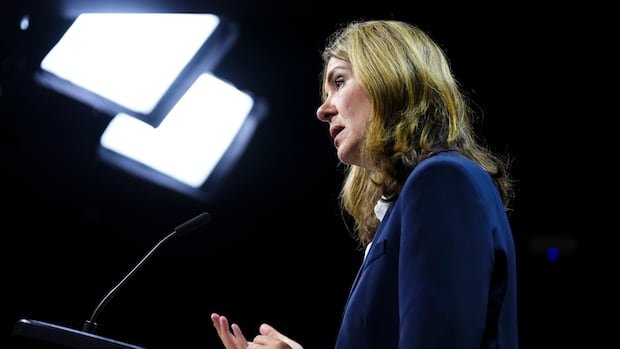

Alberta Premier Danielle Smith anticipates a significant development in the ongoing federal-provincial clash over energy policies before the 112th Grey Cup kicks off at Princess Auto Stadium in Winnipeg. The energy policies in Alberta have been gradually changing in recent months. Smith has mentioned a potential “grand bargain” and is optimistic about reaching an agreement by the CFL’s championship game on Nov. 16.
Smith expressed her expectation for the federal government to finalize a memorandum of understanding by the Grey Cup, allowing the progression towards attracting private investments back to Canada’s natural resource sector. This agreement would involve the removal or revision of what Alberta considers unfavorable laws, alongside advancing towards the approval of a pipeline to the B.C. coast.
Additionally, Smith aims for the realization of the Pathways Alliance project, a major carbon capture and storage initiative near Cold Lake. This project entails capturing carbon dioxide emissions from more than 20 oilsands facilities in northern Alberta, transporting them 400 kilometers by pipeline to a terminal in the eastern part of the province.
Conversely, Ottawa has indicated a possible abandonment of its proposed oil and gas emissions cap, a key policy during former Prime Minister Justin Trudeau’s term. In exchange, the federal government seeks robust carbon pricing, methane regulations, and increased deployment of carbon capture and storage technologies.
- Goodbye oil and gas cap? Ottawa signals it’s gone, with some caveats
- Smith says she’s open to adjusting Alberta’s industrial carbon price
Prior to presenting the budget, Finance Minister François-Philippe Champagne mentioned that there are further steps to be taken. He emphasized that the emissions cap would no longer be necessary once specific conditions are met.
Alberta’s industrial carbon tax was implemented in 2007, making it the first jurisdiction in North America to introduce a pricing mechanism for industrial carbon emissions. The current system, known as Technology Innovation and Emissions Reduction (TIER), has been in place since 2020.
Liberal MP Corey Hogan highlighted the significance of Alberta’s carbon pricing system, stressing that alignment with federal standards is crucial for avoiding the need for an emissions cap.
Furthermore, the Alberta government announced a continuation of the freeze on the industrial carbon price at $95 per tonne until 2026, maintaining a discrepancy with the federal government’s escalating backstop price targets.
Despite the changes introduced by the government to incentivize investment in emissions reduction projects, environmental groups remain skeptical and express concerns about the potential implications.
Heather Exner-Pirot from the Macdonald-Laurier Institute sees room for collaboration on carbon pricing between the federal and Alberta governments. However, achieving a consensus may require significant adjustments to the industrial carbon pricing framework.
Notably, Andrew Leach highlighted the differences between Alberta’s system and the federal approach, suggesting that any potential confrontation over carbon pricing could be challenging for Ottawa.
While the federal government is engaging in constructive discussions with Alberta and industry stakeholders, the road ahead remains uncertain regarding energy policies and emissions regulations.
The Pathways Alliance declined to comment, acknowledging that the issue is primarily between the two governments.