
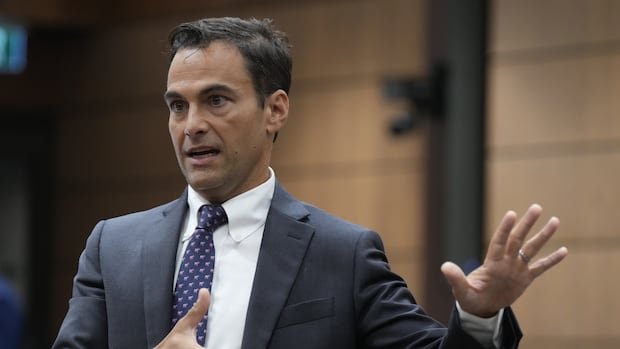

Days before Members of Parliament are scheduled to vote on the Liberal budget, interim Parliamentary Budget Officer (PBO) Jason Jacques has raised concerns about the government’s financial management, suggesting there is a less than 10 percent chance of meeting deficit targets. Despite this critique, Jacques now asserts that the government’s finances, according to the PBO’s framework, are sustainable in the long run, a shift from his earlier comments labeling Canada’s spending as “unsustainable” and “shocking.”
The report highlights Finance Canada’s alteration in reporting deficit financing by segregating capital from operational expenditures, with the PBO expressing discontent over the government’s broad definition of capital investments. The PBO analysis indicates that out of the projected $311 billion in capital spending between 2024-25 and 2029-30, only $217.3 billion should rightfully be classified as capital spending.
Given the subjectivity involved in defining capital investments, the report recommends the establishment of an independent expert body to determine qualifying federal spending categories. Prime Minister Mark Carney’s decision to differentiate day-to-day and capital spending in reporting was intended to clarify the distinction between operational government expenses and investments.
The PBO report underlines that the operational spending balance promised by Carney could have potentially reached a surplus as early as 2026-27 without the additional spending announced in the 2024 fall economic statement and the 2025 budget. The current measures are expected to keep the operating budget in deficit until 2028-29, extending beyond the government’s projections.
While the federal government anticipates an increase in the deficit-to-GDP ratio to 2.5 percent in 2025-26, subsequently declining to 1.5 percent by 2029-30, the PBO report casts doubt on the likelihood of this reduction occurring annually through 2029-30. The report suggests a mere 7.5 percent chance of the government adhering to its declining deficit-to-GDP fiscal anchor.
Jacques’s calculations foresee a decline in Canada’s debt as a percentage of GDP over the next three decades, positioning the Liberal government with a relatively sustainable fiscal stance. Finance Minister François-Philippe Champagne’s press secretary, John Fragos, emphasized that the PBO findings do not consider the potential economic growth from the budget measures, which could offer more fiscal flexibility in the future.
Former Parliamentary Budget Officer Kevin Page rated the Liberal budget with a B for fiscal responsibility, asserting that Canada’s fiscal foundation remains sustainable despite increased debt and limited fiscal capacity to address potential financial crises. The government is in search of a replacement for Jacques, aiming for a candidate with “tact and discretion” to fill the position permanently.
Conservative Leader Pierre Poilievre criticized Prime Minister Mark Carney for misrepresenting day-to-day operating spending as investments, warning that the government is unlikely to achieve deficit targets, which could negatively impact Canadians through higher costs and taxes.