
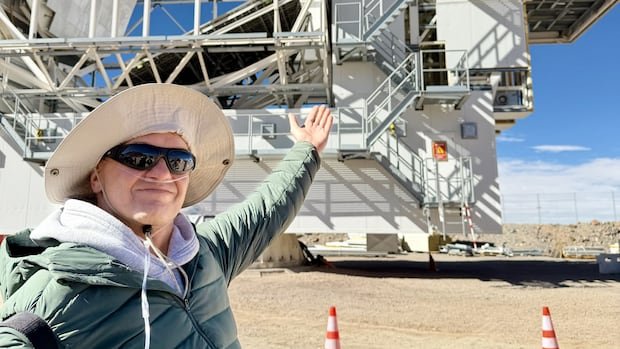

A groundbreaking new telescope, featuring the collaborative efforts of Canadian researchers, is poised to delve into profound cosmic enigmas from its strategic location among the highest peaks worldwide. Positioned at an elevation exceeding 5,600 meters in Chile’s arid Atacama Desert, the Fred Young Submillimeter Telescope commands such heights that visitors necessitate oxygen support due to its elevated atmospheric conditions.
Leading the Canadian team, Mike Fich, an esteemed astronomer from the University of Waterloo, underlines the telescope’s unique ability to provide a level of clarity akin to that previously attainable only in space missions, which carry exorbitant costs. The project aims to unravel mysteries surrounding the formation and movement of stars and galaxies, shedding light on dark energy, dark matter, and offering insights into the universe’s primordial origins.
Operated by Cornell University’s CCAT Observatory in New York in collaboration with institutions from Chile, Germany, and Canada, the project involves a consortium of Canadian researchers from various universities like the University of Toronto, the University of Alberta, McGill University, and McMaster University. The telescope’s expansive field of view sets it apart, enabling swift scanning of vast sections of the sky, a feat previously unattainable with conventional telescopes.
Noteworthy contributions from researchers at Dalhousie University, the University of British Columbia, and the National Research Council have resulted in the development of cutting-edge quantum sensor cameras designed to function at extremely low temperatures, capturing submillimeter wavelengths imperceptible to the human eye and even advanced instruments like the Hubble Space Telescope.
The Fred Young project, amounting to approximately $40 million US in costs, is supported by a dedicated computing center for data processing, with additional facilities likely to be established in North America. The complex assembly process, involving components weighing up to 55 tonnes, was meticulously executed in Germany before being transported to Chile for reassembly atop the mountain.
Anticipated milestones include the installation of Chapman’s cameras on the telescope in the upcoming summer, with initial data anticipated by mid-fall. The subsequent analysis of the vast data sets will culminate in public release of findings approximately a year later, offering new perspectives on the universe’s celestial marvels.