
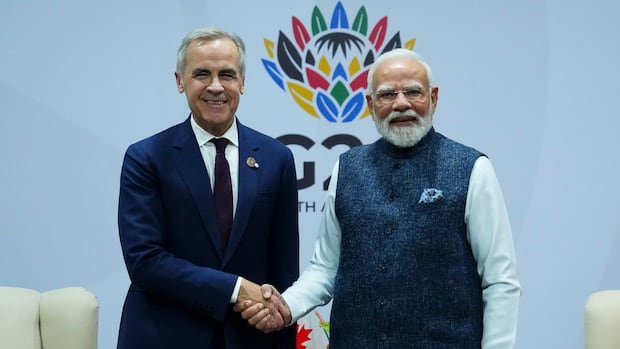

Prime Minister Mark Carney and Indian Prime Minister Narendra Modi have agreed to commence discussions on a new trade agreement named Comprehensive Economic Partnership Agreement. Carney expressed in a social media update that the potential trade deal could elevate Canada-India trade to $70 billion.
Highlighting India’s position as the fifth-largest economy globally, Carney stated that this presents significant opportunities for Canadian workers and businesses. A statement from India’s Ministry of External Affairs affirmed the agreement and extended an invitation to Carney to visit India, which he accepted for early 2026.
This development signals a positive shift in diplomatic relations between Canada and India following tensions arising from Canadian accusations linking Indian agents to the extrajudicial killing of Sikh activist Hardeep Singh Nijjar in Canada in 2023. The recent meeting between Carney and Modi at the G20 summit in Johannesburg further solidified this trend, marking their second face-to-face encounter since Carney assumed office.
Discussions on trade between the two countries have been ongoing since the G7 summit, as mentioned by Dinesh Patnaik, India’s high commissioner to Canada. While trade talks for a comprehensive deal began 15 years ago, they were downscaled to focus on specific industries until 2023 when Canada suspended negotiations due to the aforementioned allegations.
Modi shared on social media that his meeting with Carney was productive, underscoring the positive momentum in bilateral relations since their previous encounter at the G7 Summit. Despite ongoing security concerns raised by Canadian authorities regarding alleged threats from Indian entities, the governments continue to work towards enhancing trade ties.
Canada regards India as a reliable trade partner, with Carney emphasizing the importance of fostering stronger economic relations with one of the world’s leading economies. The prime minister emphasized the need for vigilance against foreign interference and highlighted collaboration with Indian law enforcement and national security agencies to safeguard Canadian interests.
As Sikhs for Justice conduct a referendum in Ottawa advocating for an independent Sikh Punjab, tensions persist over the resumption of diplomatic ties with India. The new leader of the Canadian chapter, Inderjeet Singh Gosal, criticized the premature restoration of relations, citing ongoing security threats. The Indian government views the referendum as a provocation, emphasizing its sensitivity within India.
Foreign Affairs Minister Anita Anand clarified that the meeting between Carney and Modi coinciding with the referendum was not intended to undermine domestic interests but rather focused on law enforcement dialogue and public safety concerns. The emphasis remains on fostering constructive dialogue and addressing security challenges in bilateral engagements.