
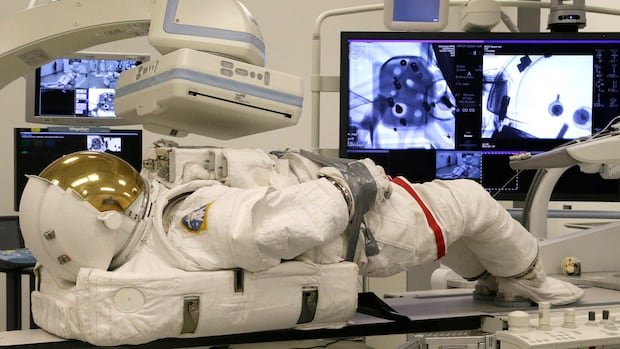

Innovative medical tools like ear thermometers, portable ultrasounds for iPhones, and virtual doctor appointments have origins in space technology. Researchers suggest that future deep space exploration will bring revolutionary advancements to Earth’s healthcare systems, such as portable medical devices and robotic care, with a focus on benefiting remote and under-resourced communities.
According to Dr. Dave Williams, a former ER doctor and astronaut from Toronto, insights gained from lunar habitats for remote medical care can be applied to regions like northern Canada. Dr. Williams and Dr. Farhan Asrar from Toronto Metropolitan University are studying potential healthcare innovations linked to deep-space missions that aim to send individuals to the Moon and eventually to Mars.
As deep-space missions become longer and farther, the need for faster communication technologies to enable virtual care is emphasized. Additionally, advancements in robot- and AI-supported care are crucial, as the time delay for a doctor’s message to reach an astronaut on Mars could hinder timely healthcare delivery. This could drive the development of wearable technology for monitoring vital signs, robotic limbs, and exoskeletons to support individuals at risk of falling or with disabilities.
The relationship between space medicine and terrestrial medicine is symbiotic, with innovations in one field influencing the other. Portable medical technology is vital in space due to restrictions on carrying heavy equipment, and the same lightweight tools can aid physicians in remote areas or during disasters on Earth.
Dr. David Saint-Jacques highlights the challenges faced by medical professionals in remote communities regarding limited resources, small medical teams, and the unavailability of immediate emergency care. He draws parallels between providing healthcare in isolated Canadian communities and in space, emphasizing the need for adaptable medical technologies.
Organizations like the Canadian Space Agency prioritize technologies that have practical applications on Earth when allocating funds, ensuring that advancements benefit both space missions and healthcare on our planet. While innovations in robotics and automated healthcare show promise, implementation on Earth can be delayed due to costs and regulatory processes.
The success of missions like Artemis II is expected to accelerate innovation in healthcare, particularly in the field of aerospace medicine. This positive momentum is anticipated to inspire more physicians to seek training in this specialized area and encourage young individuals to enter the field.