
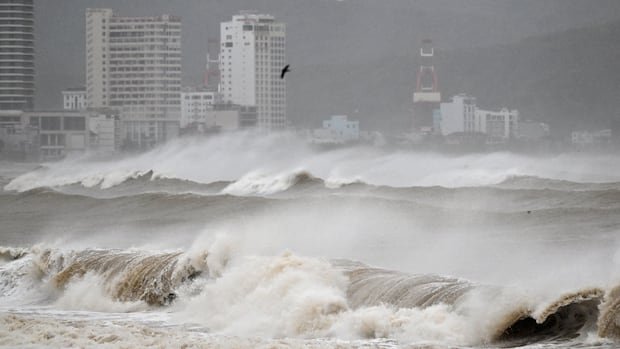

Typhoon Kalmaegi made landfall in Vietnam on Thursday, leading to the cancellation of numerous flights and issuing directives for residents to remain indoors. The storm, which originated in the Philippines and resulted in the death of at least 114 individuals, brought winds reaching speeds of up to 149 kilometers per hour, as reported by the national weather agency. The impact of Kalmaegi included the destruction of house roofs, toppling of trees and telegraph poles, and generating waves up to 10 meters high along the central coast.
In response to the storm, authorities shut down six airports, and over 260,000 people in Gia Lai province were relocated to safer locations. This marks the 13th storm to hit Vietnam this year, ranking among the most intense. The government mobilized over 268,000 soldiers for potential search and rescue missions and highlighted concerns about flooding in low-lying regions and threats to agriculture, particularly in the Central Highlands, a significant coffee-producing area.
Prior to Kalmaegi’s landfall, precautions were taken as establishments and residences near Cua Dai beach in Hoi An, a UNESCO heritage site, were secured. In the vicinity of Hue, farmers were still reeling from recent floods that claimed 47 lives. Rice farmer Nguyen Van Rin, who suffered losses from previous floods, expressed apprehension about the impending impact of Kalmaegi on his livelihood.
Aviation authorities in Vietnam anticipated disruptions at eight airports, including Da Nang International Airport, urging airlines and local entities to monitor the storm’s trajectory closely for passenger safety. Hoi An and Hue had been grappling with recovery efforts following the recent floods that claimed 35 lives.
Meanwhile, in the Philippines, nearly two million individuals were affected by Kalmaegi, leading to the displacement of over 560,000 residents, with around 450,000 seeking refuge in emergency shelters. President Ferdinand Marcos Jr. declared a state of emergency for the country in response to the widespread devastation. The province of Cebu bore the brunt of the storm’s wrath, resulting in flattened homes, overturned vehicles, and streets strewn with debris.
Over 200,000 people were evacuated in anticipation of Kalmaegi’s arrival in the Philippines. The aftermath revealed widespread destruction in Cebu, prompting efforts to clear debris swiftly to facilitate relief operations and locate missing individuals. Residents returned to find their homes in ruins, with many embarking on the challenging task of cleaning up the mud and debris left behind by the storm.
As the Philippines grapples with the aftermath of Kalmaegi, meteorologists are monitoring a potential storm forming east of Mindanao that could intensify into a typhoon, posing additional risks in the coming days. The devastation caused by Kalmaegi, the 20th storm to hit the Philippines this year, compounds the challenges faced by communities recovering from a recent earthquake that struck northern Cebu, resulting in casualties and displacements.