
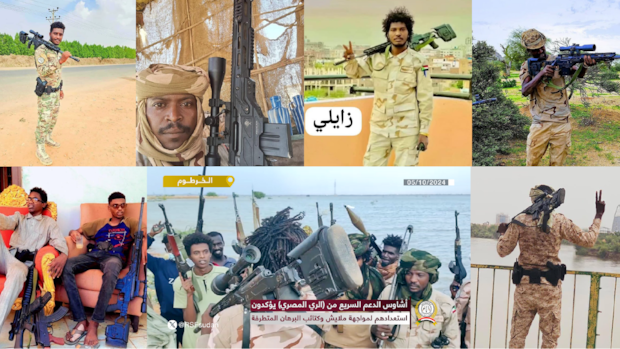

A Canadian arms manufacturer’s logo has been spotted on weapons used by a paramilitary group in Sudan, linked to attacks on civilians, as revealed by CBC’s visual investigations unit. The ongoing civil war in Sudan since April 15, 2023, has caused severe damage to civilian infrastructure, destroying healthcare facilities and creating a massive humanitarian crisis. The conflict has led to the deaths of an estimated 150,000 people and displaced over 12 million civilians internally.
Sudan’s city of El Fasher, known as the Sudanese Armed Forces’ last stronghold in Darfur, has become the focal point of the escalating war. The city was under siege by the Rapid Support Forces (RSF) for over 500 days before falling to them on Oct. 26. Subsequent reports of civilian massacres emerged following the city’s capture.
Images circulating online, verified by CBC, depict RSF fighters equipped with rifles bearing the logo of Sterling Cross Defense Systems, a firearms and ammunition producer based in Abbotsford, B.C. The authenticity of these images was confirmed by CBC’s visual investigations team through geolocation and design comparisons to Sudanese emblems.
Despite being contacted for comment, Sterling Cross did not address specific inquiries regarding their involvement in Sudan, international arms sales overseen by Global Affairs Canada, or dealings with countries linked to supplying factions in Sudan. The company’s director of operations emphasized compliance with Canadian regulations and the Export and Import Permits Act.
Sterling Cross, established in 2008, initially operated as a military broker before expanding into commercial arms production in 2011. The company’s connections abroad, notably in the Middle East, have raised questions about the origin of the weapons found in Sudan.
The proliferation of foreign weaponry in Sudan’s conflict has been highlighted by experts, with reports of arms from various countries, including Canada, reaching the RSF through channels like the United Arab Emirates. Streit Group, a Canadian firm, has also been implicated in supplying armoured vehicles to the RSF, contributing to the conflict’s escalation.
Calls for improved transparency and accountability in Canada’s arms export tracking mechanisms have been emphasized, urging stricter monitoring of weapons post-export to prevent unauthorized distribution. Experts stress the need for enhanced legal measures to effectively regulate arms trade and prevent weapons from reaching conflict zones unlawfully.