
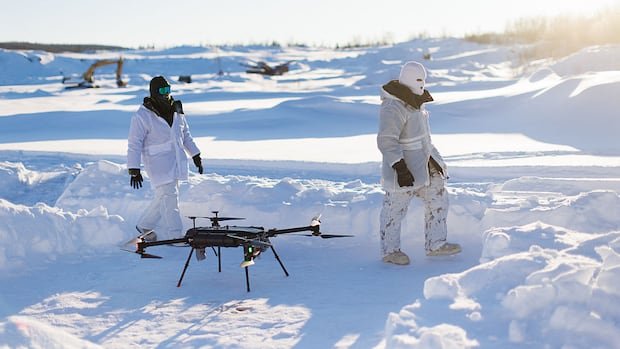

A recent study from the Center for European Policy Analysis indicates that Russia and China are leading the way in the development and deployment of drones capable of functioning in challenging Arctic environments, outpacing NATO countries like Canada.
The report, published this week, highlighted deficiencies in infrastructure, questioned the sufficiency of investments, and identified procurement barriers that impede the incorporation of unmanned systems into Western armed forces.
According to the study authored by research fellow Federico Borsari and retired U.S. Major-General Gordon (Skip) Davis, both Russia and China are enhancing their unmanned capabilities and defensive measures, expanding their presence in the Arctic, and exploiting surveillance and security weaknesses.
Russia, influenced in part by developments in the Ukraine conflict, is heavily investing in unmanned and robotic systems across various domains to address capability gaps and reinforce conventional forces. The CEPA study mentioned that annual drone production surpasses 1.5 million units, with Russian unmanned systems expected to increase significantly in the near future.
Similarly, China is focusing on the advancement of remote-sensing technology, polar shipping, unmanned systems, and communication networks in the Arctic. Recent reports from Chinese media revealed successful tests of a new unmanned aerial vehicle named Jiutian, capable of launching smaller drones mid-flight.
Canada currently lacks drones suitable for Arctic surveillance. The Canadian Air Force is in the procurement process for 11 MQ-9B Reaper drones from General Atomics, with initial deliveries slated for 2028 and full operational capacity by 2033.
The initiative faced delays to modify the drones for Arctic operations, with additional testing and qualification required to ensure functionality in harsh winter conditions. Transport Canada has acquired an Israeli-made Hermes 900 Starliner drone for Arctic surveillance, although deployment details remain uncertain due to aviation service reorganization.
The CEPA report emphasized the critical need for Canada and the United States to address the drone gap in the northern region. The report highlighted the aging radar networks of the North American Aerospace Defense Command (NORAD) and emphasized the importance of modernization to safeguard against emerging threats.
The study underscored the urgency for NATO nations to bridge existing gaps between current drone capabilities and the specific requirements for Arctic missions, stressing the need for cold-rated batteries, thermal management systems, and spare parts prepositioning for sustained operations in extreme Arctic conditions.
At a strategic level, the report called on NATO to take the surveillance gap more seriously and emphasized the lack of a formal Arctic strategy within the organization, urging the development of a dedicated strategic framework to enhance coordination and resource allocation among regional allies.