
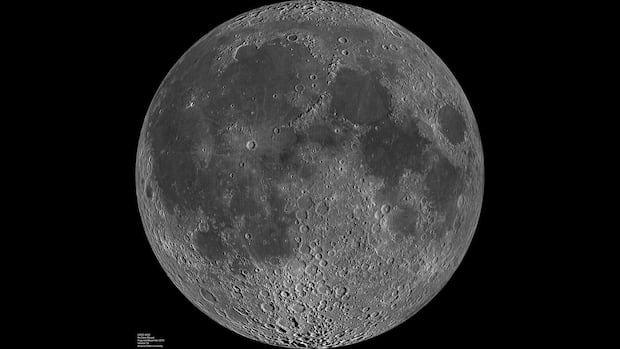

In the early hours of Wednesday, telescopes worldwide will aim to capture a unique event: an aging rocket crashing into the moon’s illuminated side. This rocket is the second stage of a SpaceX Falcon 9 that launched two commercial lunar landers, Firefly Blue Ghost-1 from the U.S. and ispace Hakuto-R Resilience from Japan, back in January 2025.
Independent astronomer Bill Gray, who tracks celestial objects, predicted this collision last September after noticing the rocket’s trajectory would intersect with the moon on August 5, 2026. Determining the precise orbital data was challenging due to the subtle gravitational forces exerted by the sun in addition to the moon and Earth.
Further analysis revealed that the rocket was not merely passing close to the moon but was on a collision course with it. The impact is anticipated to occur on the moon’s daylight side near the limb.
Human-made objects colliding with the moon are not unprecedented, with previous incidents involving Apollo upper stages and intentional impacts for scientific inquiry or orbital clearance. Notably, NASA’s Lunar Crater Observation and Sensing Satellite and ESA’s SMART-1 spacecraft have impacted the moon, with the latter leaving a significant crater upon impact.
Astronomers are eager to observe this upcoming impact event, scheduled for August 5 at 2:34:32.9 a.m. ET, particularly those in central and eastern Canada, the U.S., the Caribbean, and parts of South America for optimal viewing. The rocket’s collision is expected to eject a debris plume, potentially releasing over one million kilograms of material into space before most of it settles back onto the lunar surface.
Observations of the impact are crucial for gathering valuable data on potential risks posed by artificial impacts as human missions to the moon become more frequent. Understanding these hazards, both direct and indirect, is essential for future lunar exploration and ensuring astronaut safety.
While the likelihood of an astronaut being hit by debris remains low, monitoring such events provides insights into the risks posed by artificial impacts on lunar activities. Gray continues to track various objects in space, including China’s Chang’e 3 rocket upper stage, emphasizing the importance of ongoing monitoring and risk assessment in space exploration.