
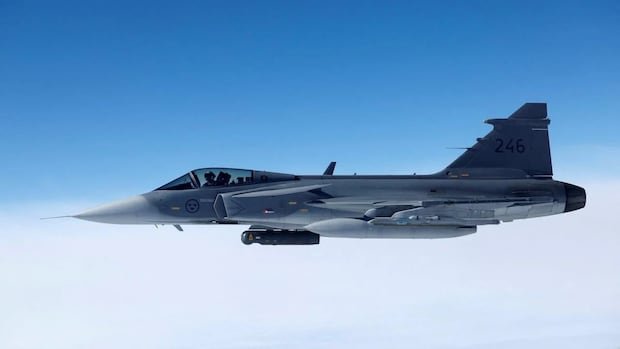

Saab, the Swedish aerospace company, would need to sell 72 Gripen fighter jets and six GlobalEye surveillance aircraft to fulfill its commitment of generating 12,600 job opportunities in Canada, as per insights obtained by CBC News. Both aircraft proposals from Saab are currently under evaluation by defense and economic experts in Ottawa.
Earlier indications from Saab suggested the potential creation of around 10,000 jobs in Canada, but the specific quantity of aircraft orders required for this job creation target had not been publicly disclosed. The Carney government is keenly interested in Saab’s initiatives as it aims to diversify Canada’s military equipment sources and bolster its industrial sector, which has faced challenges due to tariffs imposed by former U.S. President Donald Trump.
Industry Minister Mélanie Joly emphasized the government’s focus on projects that enhance Canadian security, sovereignty, and job creation across the nation. Saab’s commitment to deliver 12,600 jobs is directly tied to the sale of Gripen and GlobalEye aircraft to Canada, as confirmed by Saab Canada President Simon Carroll.
Saab plans to establish production centers in Ontario and Quebec, along with a nationwide supplier network, to manufacture fighter jets and surveillance aircraft for the Royal Canadian Air Force and potential international clients like Ukraine, France, and Germany. The GlobalEye aircraft, developed in collaboration with Bombardier, utilizes Bombardier’s Global 6500 jets as the platform for various surveillance systems and radars, known as the airborne early warning and control (AEWAC) system in Canada.
The procurement of a Gripen fleet would impact Canada’s existing plan to acquire 88 F-35 aircraft, with ongoing discussions between the Canadian government and Lockheed Martin, the manufacturer of the F-35. Despite considerations to reduce the F-35 order, Canada is set to receive 16 F-35s this year, raising concerns among military experts about integrating two distinct fighter jet fleets simultaneously.
While Saab’s job promises are gaining attention, further scrutiny is warranted, according to defense industry experts. The decision to acquire Gripen aircraft should prioritize military requirements over economic and political factors, as highlighted by military analyst Justin Massie. Questions persist regarding the integration of Swedish Gripens into NORAD’s defense systems, underscoring the need for a balanced decision-making process.
A recent survey revealed varying preferences among Canadians regarding fighter jet choices, with the Gripen attracting significant support, particularly from NDP and Liberal Party supporters. Regional disparities exist in these preferences, with Quebec and British Columbia showing contrasting views on fleet options. The ongoing debate between the Gripen and the F-35 extends beyond technical aspects to considerations of international alliances and economic impacts.
In the evolving landscape of Canada’s defense procurement, Ottawa faces critical decisions that not only impact national security but also economic growth and international relationships. The choice between the Gripen and the F-35 represents a complex balancing act, requiring a strategic approach that aligns with Canada’s overarching defense and economic objectives.