
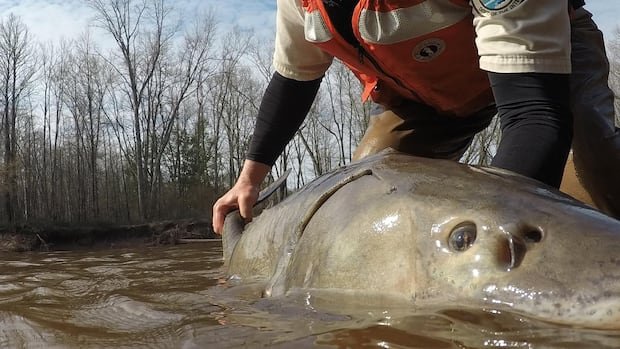

Lake sturgeon found in the Great Lakes today could potentially be over 400 years old, according to recent research. These ancient-looking armored fish, which can reach lengths of up to two meters and weigh as much as 180 kilograms, are facing endangerment in the Great Lakes region and are listed as a species at risk in Ontario.
Historically, overfishing and habitat destruction have severely impacted lake sturgeon populations, leading to a drastic decline in their numbers. Even today, efforts are underway to help these fish recover, including raising and releasing young sturgeon into the waters.
A study conducted using data spanning over four decades from captured and recaptured sturgeon in the Great Lakes revealed that these fish could live much longer than previously believed. Traditional methods of age estimation, such as counting growth rings, have limitations as sturgeon grow slower as they age, making it challenging to determine their exact age.
Researchers, led by Ed Baker from the Michigan Department of Natural Resources, analyzed growth patterns of individual sturgeon over time to estimate their ages more accurately. The study unveiled some sturgeon living for several centuries, surpassing prior assumptions.
This newfound understanding of lake sturgeon’s longevity poses significant implications for conservation efforts. Trevor Pitcher, a biologist at the University of Windsor, emphasized the need to reevaluate conservation strategies for a species that could live for centuries. The current century-long conservation plan in Canada may require adjustments to ensure the long-term survival of these ancient fish.
Pitcher highlighted the vital role sturgeon play in the ecosystem, particularly in controlling invasive species like quagga mussels and gobies. By restoring sturgeon populations, the balance of the aquatic food web can be preserved, benefiting the overall health of the Great Lakes.
Moreover, the cultural significance of lake sturgeon extends beyond their ecological importance. In Indigenous traditions, sturgeon are revered as elders due to their longevity and ancestral connections. Perry McLeod-Shabogesic, an elder from Nipissing First Nation, emphasized the spiritual significance of sturgeon as beings that bridge different worlds, embodying unique qualities that set them apart from other fish.
The latest findings on sturgeon’s potential centuries-long lifespan align with Indigenous teachings and ancestral knowledge, reinforcing the deep-rooted understanding of these remarkable creatures. The study sheds light on the importance of adapting conservation practices to safeguard species with such enduring lifespans.