
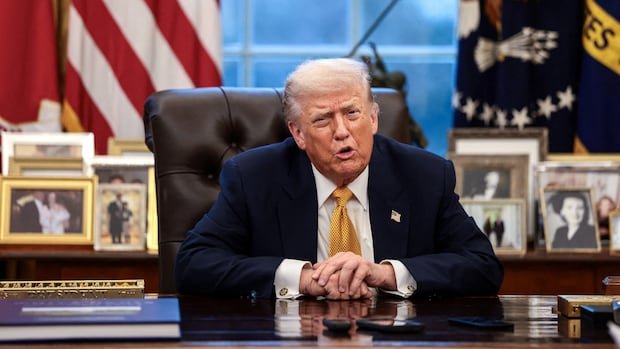

Venezuelan opposition leader Maria Corina Machado visited the Oval Office on Thursday and presented President Donald Trump with a Nobel Peace Prize. While it remains uncertain if Machado will receive anything in return, the gesture exemplifies a trend of foreign entities lavishing gifts on the White House.
Recently, the government of Pakistan inked a deal with crypto company SC Financial Technologies to explore the use of a stablecoin named USD1. The CEO of SC Financial Technologies, Zachary Witkoff, is the son of Steve Witkoff, a New York real estate mogul and Trump’s Mideast and Russia envoy. The stablecoin USD1 was developed by World Liberty Financial, a crypto firm co-founded by Witkoff, Donald Trump Jr., Eric Trump, and Barron Trump.
This strategy mirrors a tactic employed by the United Arab Emirates in April 2025. A U.A.E. state-owned fund invested $2 billion US of World Liberty cryptocurrency in Binance, the world’s largest crypto exchange. Subsequently, the U.S. lifted its ban on selling advanced AI-suitable chips to the U.A.E., enabling the launch of a major non-U.S. AI project. Additionally, Binance founder Changpeng Zhao from Canada received a presidential pardon for financial crimes after a meeting with Zach Witkoff in Abu Dhabi.
Various foreign governments and corporations have found ways to funnel money to the Trumps and select New York families linked to Trump. Crypto presents a discreet and challenging-to-trace method for enriching the Trump and Witkoff families.
According to Princeton University sociology and international affairs professor Kim Lane Scheppele, Trump is arguably the most openly corrupt U.S. president, leveraging his office for personal profit. Estimates indicate a substantial increase in his wealth since assuming office.
Foreign governments have transitioned from crude methods like booking rooms at Trump hotels to more profitable arrangements involving crypto and licensing. The lack of transparency in Trump’s dealings with foreign leaders and emissaries like Witkoff and Jared Kushner has raised concerns about potential undisclosed agreements.
Despite constitutional provisions against emoluments, enforcement has proven challenging, allowing Trump to continue his business dealings worldwide. The Trump organization has engaged in lucrative golf-related projects with Gulf countries while negotiating political and military matters, raising ethical concerns over conflicts of interest.
Notably, even democracies like Switzerland have resorted to offering extravagant gifts, such as a gold brick, to the Trump administration to secure favorable trade terms. Traditional diplomacy appears less effective, with countries struggling to navigate Trump’s personal interests versus national concerns.
The pattern of foreign entities providing gifts to the Trump administration, including the acceptance of a luxury Boeing 747 jetliner from Qatar, underscores ongoing ethical dilemmas and regulatory loopholes in the current political landscape.