
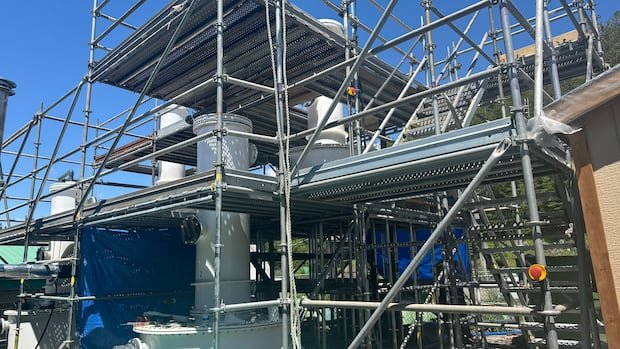

A new initiative in Nova Scotia is experimenting with a technique to capture and retain more carbon in the ocean, utilizing a fresh trial facility to validate the concept. The ocean presently serves as a significant reservoir for surplus carbon dioxide, having assimilated roughly 30% of all human-induced carbon emissions since the 1980s. The startup company pHathom aims to further extract emissions from the atmosphere by trapping carbon dioxide and transforming it into a form suitable for secure storage in the ocean over millennia. Their methodology will be trialed at the Huntsman Marine Science Centre, a nonprofit research and educational institution in St. Andrews, N.B.
Kimberly Gilbert, the co-founder and CEO, emphasized that the pilot phase is crucial for demonstrating the safety and efficacy of their approach. pHathom’s process imitates a natural occurrence where raindrops absorb carbon dioxide from the air, becoming mildly acidic. When these raindrops interact with alkaline rocks like limestone, a portion of the rock dissolves, diminishing the water’s acidity and converting the carbon dioxide into bicarbonate. Subsequently, this bicarbonate can be sequestered in the ocean for tens of thousands of years, preventing the release of carbon dioxide into the atmosphere. The company replicates this process within a reactor by introducing seawater to the emissions of a biomass power plant, acidifying the water, mixing it with small limestone particles to convert the carbon dioxide to bicarbonate, and then reintroducing it into the ocean with a pH level akin to regular seawater.
Multiple companies in Nova Scotia are exploring various versions of carbon removal techniques, focusing on alkalinity enhancement. These include Planetary, conducting a project in Tufts Cove, Halifax, to enhance seawater pH by adding alkaline rock for increased carbon dioxide absorption, and CarbonRun, implementing a similar strategy in Nova Scotia rivers. pHathom’s method stands out for its utilization of concentrated carbon dioxide, enhancing process efficiency. The pilot project aims to capture 0.1 tonnes of carbon dioxide daily, offering a tangible scale against emissions from the Belledune coal-fired power plant in northern New Brunswick. The initiative also produces treated water for testing tanks, evaluating its impact on diverse marine species over a three-month period.
Davide Asnicar, an associate research scientist at the Huntsman Marine Science Centre, highlighted the abundance of inquiries surrounding pHathom’s innovative process. If successful, the company plans to expand with a second test site in Nova Scotia next year, integrating their reactor into a facility transitioning from a fossil-fuel boiler to a biomass system. Despite the potential of carbon removal technologies, scaling remains a significant challenge. To limit global warming to 1.5°C, models from the Intergovernmental Panel on Climate Change (IPCC) suggest a need to scale global carbon dioxide removal to between 10 and 20 gigatonnes per year.
While acknowledging these challenges, Katja Fennel, a lead investigator of the Ocean Alk-Align research consortium at Dalhousie University, emphasized the importance of exploring promising removal technologies in light of the climate crisis but stressed the necessity of continuing efforts to move away from fossil fuels. Canadian Senate reports have recognized Canada’s leadership in ocean alkalinity enhancement research, urging federal action for international implementation and regulatory frameworks. However, recent modifications to the industrial carbon price have introduced uncertainty, impacting the financial viability of several Canadian carbon capture and storage projects.
Nevertheless, Gilbert remains optimistic that global economic and environmental circumstances will eventually drive action towards proven technologies. She anticipates that when the world refocuses on climate issues, they will be prepared to contribute.