
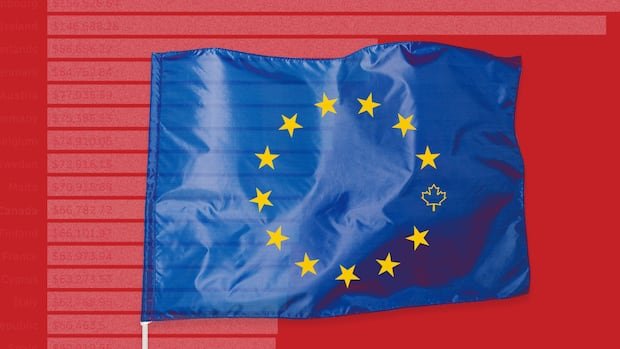

The European Union is eyeing Canada to potentially become its inaugural “associate member” among its 27 member nations, reflecting a global shift towards expanding trade relations beyond the United States. In a recent state of the union address, European Commission President Ursula von der Leyen emphasized the need for the EU and Canada to reenvision their partnership beyond a mere free-trade agreement.
Canadian Prime Minister Mark Carney also embraced the idea of closer ties in his address, highlighting Canada’s pursuit of “resilience” in addition to open markets and sovereignty. He proposed enhanced integration in critical sectors such as artificial intelligence, defense, energy, research, and finance to strengthen the partnership.
Although the designation of “associate member” is not currently established in EU regulations, Canada is expected to enhance its trade links with Europe regardless of the outcome. Comparing Canada’s economy to potential European peers, data on GDP per capita shows Canada positioned midway among EU countries, surpassing nations like France, Italy, and Spain.
Regarding inflation rates, Canada has fared relatively well compared to many EU members, maintaining a 2% inflation rate in 2025 and showing more resilience through the pandemic. However, the EU is grappling with elevated energy prices due to ongoing conflicts in the Middle East. The eurozone has responded by increasing interest rates to combat rising inflation.
Analyzing the total debt-to-GDP ratio, Canada would rank among the highest in the EU if it were a member, trailing behind France, Italy, and Greece. The International Monetary Fund has urged Canada to prioritize reducing this ratio in its fiscal planning. While Canada is projected to have the lowest net debt-to-GDP ratio in the G7, it differs from the total debt-to-GDP metric as it considers subtracting financial assets held by the government.
In terms of trade, Canada’s current relationship with the EU involves importing around $92 billion worth of goods and exporting about $39 billion annually. Germany plays a central role in this trade dynamic, with Canada importing machinery, vehicles, and pharmaceuticals while exporting energy products, ore, and precious metals.
The potential for Canada to join the EU as an associate member signals a significant shift in global trade dynamics, with both parties aiming to deepen their partnership beyond traditional trade agreements.
[Source: CBC News]