
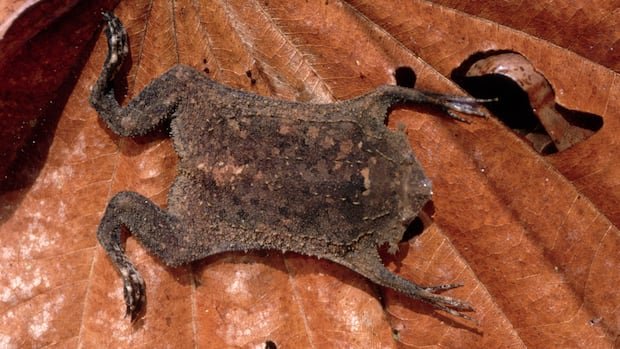

In a remarkable discovery, researchers in California have uncovered a fascinating ability of the Surinam toad – the use of its star-shaped fingertip lobes as a form of sensory perception. Despite its peculiar characteristics such as being flat-bodied, nearly blind, and lacking a tongue, this toad has proven to be a skilled hunter in the murky waters of the Amazon basin.
For over two centuries, scientists have been perplexed by how the Surinam toad exhibits such swift and precise hunting skills despite its limitations. With its unique method of detecting nearby prey and swiftly capturing them into its mouth in mere hundredths of a second, this toad has defied expectations.
A recent study by Duncan Leitch and his team at the University of California, Los Angeles, published in the Journal of Comparative Physiology A, has shed light on this mystery. The research reveals that the toad, often referred to as a star-fingered toad, utilizes its fingertip lobes to sense subtle movements in the water created by potential prey.
These finger lobes, resembling a fractal pattern, act as highly sensitive touch organs akin to the fovea in the human eye. They can discern the size and proximity of prey by processing signals collected by neurons, allowing the toad to engulf its target without direct physical contact, even in darkness.
Remarkably, each frog possesses 128 tiny lobes across its fingertips, which are densely covered with papillae – dome-shaped bumps known to enhance touch sensitivity. Despite constituting only a small portion of the frog’s skin, these lobes house a significant majority of touch-sensitive nerves in the front legs.
The research findings suggest a sophisticated sensory adaptation in these toads, reminiscent of strategies observed in more complex mammalian brains. This unexpected similarity in evolutionary solutions between frogs and mammals, despite their distinct evolutionary paths, underscores the remarkable adaptability of vertebrate species.
Lea Randall, a conservation program senior manager at the Wilder Institute in Calgary, emphasized the significance of this discovery in understanding vertebrate brain evolution. She highlighted the insights gained from studying how frogs have evolved to optimize sensory information processing, offering valuable perspectives on the development of neural systems across different vertebrate groups.