

Residents of Alberta tuning in to the recent state of the union address by the U.S. president might have felt a sense of familiarity with Donald Trump’s remarks on AI data centers: “We’re instructing major tech firms to address their own energy requirements.”
In Alberta, the UCP government has been promoting the “bring your own generation” concept as part of its strategy to attract investments exceeding $100 billion for AI data centers.
Despite the U.S. having more advanced AI infrastructure, Alberta is keen on seizing the opportunities presented by the AI industry, leveraging its cold climate, vast land availability, and deregulated electricity market.
Let’s delve into the comparison between Alberta’s data center expansion and that of the U.S.
Adopting a Staged Approach
In response to the surging demand from companies seeking grid connectivity, the Alberta Electric System Operator (AESO) identified 1,200 megawatts to allocate to large data center projects without compromising grid stability, as announced last June.
Notably, Frank Felder, a U.S.-based independent power consultant specializing in data centers, highlighted differences in approach between Alberta and several U.S. wholesale electricity markets, where data center expansion sometimes precedes capacity considerations.
Felder mentioned that U.S. regional transmission organizations and independent system operators have not adopted a phased approach like Alberta.
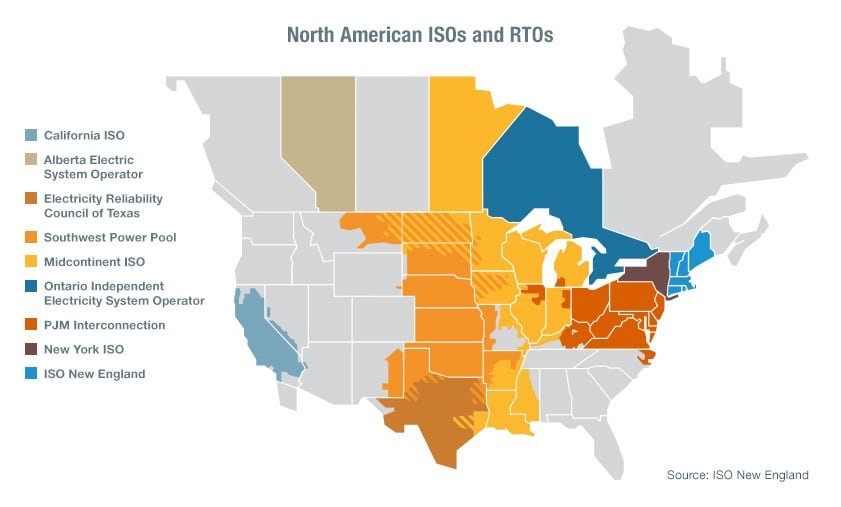
He explained, “These markets don’t pre-allocate a specific capacity for data centers to connect, leading to potential imbalances in supply and demand that could affect wholesale prices and grid reliability.”
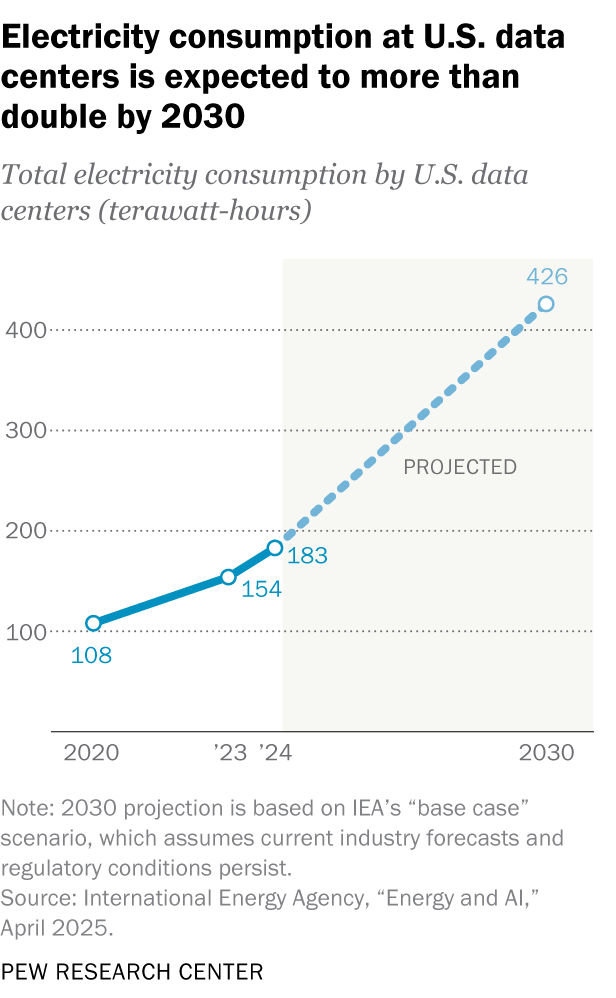
According to the Pew Research Center, U.S. data centers consumed over four percent of the nation’s total electricity in 2024, equivalent to the annual power usage of Pakistan.
By 2030, U.S. data center electricity consumption is forecasted to surge by 133%.
Compared to the U.S., Alberta’s AI data center expansion is relatively new. While several large projects have been proposed, such as a significant facility in Olds, Alberta, many are still in the preliminary stages.
Ryan Li, a professor at the University of Alberta, commended Alberta’s cautious approach, emphasizing that AESO’s careful planning reflects a deep understanding of the grid’s dynamics.
Li added, “The allocated power (1,200 megawatts) for these centers is a reasonable fraction, less than 10% of the province’s current load.”
In 2024, at the onset of Alberta’s AI data center initiative, Technology Minister Nate Glubish highlighted the province’s appeal to companies due to its electricity market structure facilitating off-grid power generation.
Li explained, “Our power system isn’t designed to support these data centers at scale. That’s why the emphasis is on companies generating their own power due to the current limitations.”
Impact on Electricity Rates
During the recent state of the union address, Trump introduced the “ratepayer protection pledge” to shift