
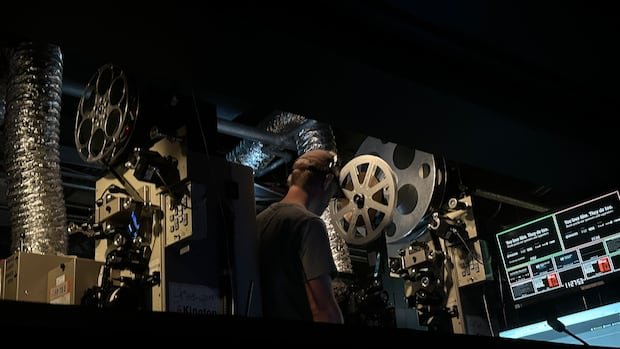

Jaime Rebanal has devoted a significant portion of his life to traditional film. He makes a point to attend nearly all celluloid movie showings available in Toronto, sometimes catching multiple screenings in a day.
Despite being just 27 years old and growing up in the digital age of Hollywood, Rebanal, a filmmaker himself, expresses a deep fascination for film. He emphasized the intricate details that analog film captures, which he believes are not replicated in digital formats. His remarks came during an event at the Toronto International Film Festival’s (TIFF) Lightbox in Toronto, focusing on film formats and part of a retrospective on director Christopher Nolan ahead of his latest film, The Odyssey. The event showcased a prominent Imax camera, noted as Nolan’s favorite.
Contrary to common stereotypes about young people being overly attached to smartphones and disconnected from social interactions, some are leading a resurgence in analog film experiences at movie theaters. They seek immersive and communal experiences that are not easily attainable online or at home.
Imax, renowned for its colossal screens and immersive sound, exemplifies this trend. The Odyssey stands out as the first narrative feature entirely shot on 70-mm Imax film, resonating with audiences who appreciate the brand’s commitment to quality.
The entertainment industry faced severe setbacks due to the COVID-19 pandemic and subsequent disruptions like actors’ and writers’ strikes, prompting executives to strategize ways to entice audiences back to cinemas. Notably, young Canadians under 35 make up a significant portion of moviegoers, with 85% reported in a 2025 Telefilm Canada study, compared to 54% for those above 35. The appeal of analog film screenings is also evident, with a noticeable presence of younger viewers at TIFF screenings of classic films like Top Gun, 2001: A Space Odyssey, and Vertigo.
Janine Marchessault, a York University professor, highlighted the evolving interest among Gen-Z in the materiality of media, particularly due to their exposure to films on smartphones. She noted a growing cinephile culture among both older generations who appreciate analog film from their upbringing and younger individuals who independently recognize its artistic value.
While the film industry has largely shifted to digital production for cost and convenience reasons, the unmatched resolution and unique grain pattern of large-format analog film continue to captivate audiences. The distinct visual appeal of analog film, characterized by crystal structures instead of pixels, contributes to its enduring allure.
Analog film enthusiasts, including young cinephiles, are drawn to the authenticity and communal experience of watching films in theaters, especially after the isolating effects of lockdowns. This resurgence underscores a broader desire for tangible, authentic experiences in a digital age.
Imax’s Mark Welton credits social media for educating young audiences on technical aspects of film, such as distinguishing between different formats like 70-mm and 35-mm screenings. Director Ryan Coogler’s video explaining film formats garnered widespread attention, showcasing the growing interest in technical knowledge among young film enthusiasts.
As younger audiences deepen their appreciation for analog film, platforms like Discord facilitate community engagement and shared viewing experiences. Movie clubs and coordinated ticket purchases for screenings like The Odyssey reflect a collective passion for visual quality and immersive storytelling.
Analog film continues to hold a near-mystical appeal for many enthusiasts, with one presenter likening it to a medium that captures memories akin to how one remembers reality. The allure of analog film was palpable at the TIFF event, where attendees engaged fervently with presenters and marveled at the revered Imax camera favored by Christopher Nolan.
In conclusion, the resurgence of analog film among young audiences underscores a shift towards tangible, communal experiences and a renewed appreciation for the unique qualities and immersive nature of traditional film formats.