
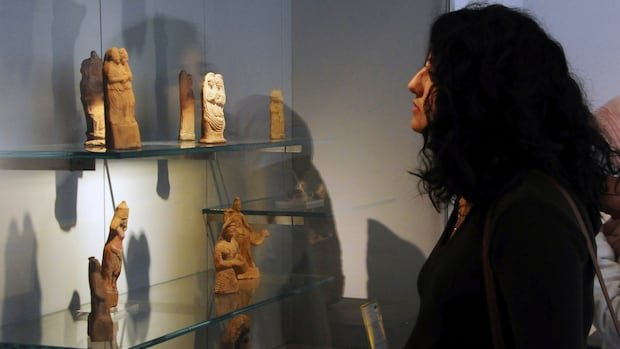

Several ancient statues from the Roman era were stolen in a burglary at the national museum in Syria’s capital, officials revealed on Tuesday. The National Museum of Damascus was shut down temporarily after the theft was discovered early on Monday. The museum had reopened recently amidst the aftermath of the country’s 14-year civil war and the termination of the 54-year Assad family regime last year.
The museum, Syria’s largest, contains priceless antiquities spanning the nation’s extensive history. Following the commencement of the war, security measures were heightened with the installation of metal gates and surveillance cameras.
An official from Syria’s Directorate-General of Antiquities and Museums informed The Associated Press that six marble statues were taken, and an investigation is currently underway. Another official stated that the robbery occurred on Sunday night and was detected early Monday when a broken door was found in the classical department, with several Roman-era statues missing. The exact number of stolen statues was not disclosed by the official.
The police chief in Damascus, Brig.-Gen. Osama Atkeh, later reported to state news agency SANA that numerous statues and rare artifacts were stolen from the museum. He mentioned that both guards and other individuals were being interrogated in connection to the incident.
A journalist from the AP who attempted to access the museum was informed by guards that photography was prohibited. The Directorate-General of Antiquities and Museums later announced in a statement that an investigation had been launched, and immediate measures were taken to ensure the security of the artifacts within the museum. However, no specific details were provided on the stolen items, with the statement only referencing that “some exhibits” were missing.
The section of the museum where the theft occurred is described as “a beautiful and historically rich department, with artifacts dating back to the Hellenistic, Roman, and Byzantine periods,” according to Maamoun Abdulkarim, the former head of the government’s Antiquities and Museums Department.
The museum had reopened on January 8, following the ousting of President Bashar al-Assad by rebels, marking a new chapter for the country. Fearing potential looting, the museum had closed its doors after the swift offensive that ended the Assad family’s rule of five decades.
Amidst the conflict in Syria that began in March 2011, authorities had relocated numerous invaluable artifacts to Damascus from various regions, including the historic town of Palmyra, previously under the control of ISIS. In 2015, ISIS militants destroyed mausoleums in Palmyra’s UNESCO World Heritage site, renowned for its ancient Roman colonnades, ruins, and priceless artifacts.