

Innovative Clothing Driven by AI Technology
Picture a scenario where artificial intelligence (AI) is seamlessly integrated into your wardrobe essentials like shirts, shoes, and socks. Toronto-based startup Aurmada is at the forefront of a trend where companies and designers are leveraging AI to revolutionize clothing and footwear, exploring ways to make them more interactive by monitoring aspects such as your walking pattern and proximity to others.
According to a recent survey by Leger, nearly 40% of Canadians own wearable technology, with smartwatches dominating the market. However, Aurmada’s CEO, Zavosh Zaboliyan, aged 36, believes that clothing will soon incorporate technology beyond just accessories, asking why our attire hasn’t kept pace with our technological advancements.
The inspiration behind Aurmada stemmed from Zaboliyan’s personal experience of recovering from a car accident injury, where he sought real-time insights into his gait to aid in his rehabilitation process. He emphasized the constant signals our bodies emit and the need for advanced tools to interpret them effectively.
The potential applications of AI-infused clothing are vast, ranging from monitoring vital signs and transmitting data to healthcare providers to tracking movements and detecting blind spots, Zaboliyan explained.
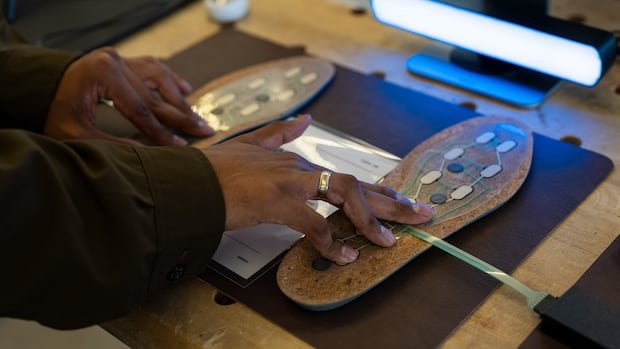
Aurmada, launched in October, showcased its innovations at a recent tech event in Toronto. The exhibited products included shoe sole sensors capable of gauging weight distribution, aiding in injury recovery affecting mobility. The team is also developing minuscule sensors that can be seamlessly integrated into clothing, functioning as virtual assistants powered by AI.
To ensure functionality, Aurmada is exploring fabrics with metallic components like copper and silver to shield embedded sensors from external signal interference. Zaboliyan also envisions incorporating lightweight solar panels into the fabric to power the internal technology.
Besides cutting-edge AI solutions, Aurmada is venturing into “low-tech” offerings like a vest with a device for temperature control and jackets featuring built-in fans powered by portable chargers for cooling relief.
While prototypes are underway, the company has already introduced non-AI products like Kevlar-based bulletproof shirts and electrically conductive socks for muscle stimulation.
The melding of technology and fashion is not new, with designers experimenting for years. Adobe unveiled a color-changing dress in 2023, while Levi’s collaborated with Google in 2020 to create a smart jacket connecting to smartphones for music playback and alerts via embedded sensors.
Institutions like the Fashion Institute of Technology’s DTech Lab in New York serve as hubs for technological fashion experiments. Innovations include a jacket responsive to external stimuli like social media feeds and a garment with conductive fibers tracking physiological data to offer comfort during anxious moments.
Envisioning a future where AI features become mainstream in fashion and specialized apparel, Aurmada targets sectors like security, defense, and manufacturing for its sensor-based solutions detecting potential hazards and enhancing situational awareness.
Despite the promising prospects, the AI-enhanced clothing sector faces challenges related to data privacy and public apprehensions about AI. Janey Park, a wearable tech and fashion enthusiast, predicts a slow adoption curve due to normalization hurdles but anticipates a trend towards stylish and functional wearable technology in the coming years.
The convergence of fashion and technology holds immense potential for reshaping everyday wearables and enhancing user experiences.