
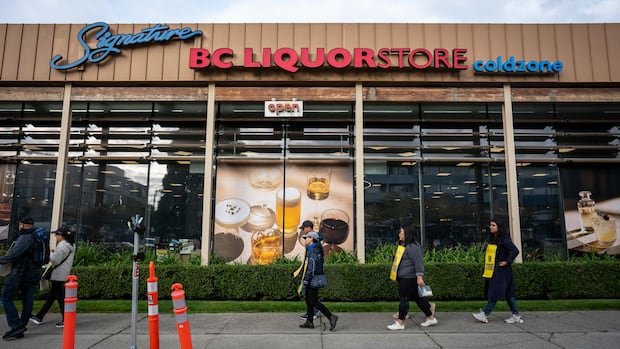

Picket lines were established on Wednesday outside all remaining government-operated liquor and cannabis stores in British Columbia as unionized public service workers intensify their job action. The B.C. General Employees’ Union (BCGEU) expanded the protest to include all Service B.C. workers, bringing the total number of participating members to nearly 25,000.
BCGEU President Paul Finch expressed regret over the pickets’ impact on local communities, emphasizing that the union’s decision to escalate the action was not taken lightly. Finch stated that the union feels compelled to push for negotiations with the government to resolve the ongoing dispute.
The bargaining unit comprises 34,000 members, including some classified as essential workers. While private liquor and cannabis stores in B.C. remain operational, they rely on supplies from government distribution warehouses, which are also affected by the picket lines.
Service B.C. offers various services to residents, such as driver’s licensing, income assistance, hunting and fishing licenses, identification verification, traffic ticket payments, student loans, and court fines. The union reported that 431 provincial government work sites are now impacted by the labor dispute.
On the first day of the government’s fall session, union members gathered outside the B.C. Legislature to demand higher compensation. B.C. Finance Minister Brenda Bailey, representing the government in the negotiations, emphasized the need to reach a fair agreement within the constraints of the province’s fiscal situation.
Finch highlighted that the union’s goal is not solely focused on wage increases but also on enhancing essential services for the province’s residents. The ongoing strike has raised concerns for the hospitality industry, with Restaurants Canada advocating for the permission to purchase liquor from private stores due to the disruptions in the government supply chain.
Minister Bailey acknowledged the challenges faced by businesses due to the strike and reiterated the government’s commitment to returning to negotiations. Health Minister Josie Osborne assured that the strike would not impede the distribution of flu and COVID-19 vaccines during the season.
The protest action continues as the union seeks to engage in constructive dialogue with the government to reach a mutually beneficial resolution to the labor dispute.