
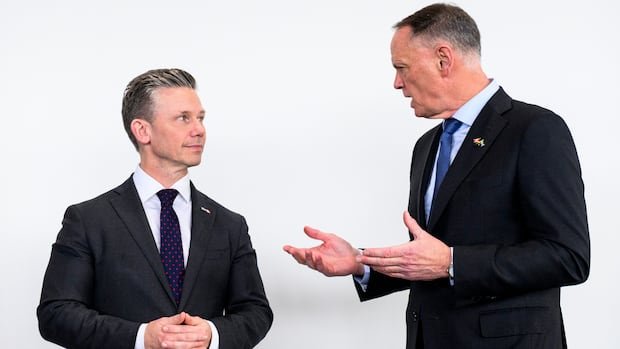

Canada’s strong aviation industry and aerospace expertise position it favorably for expanding aircraft production, such as Saab’s Gripen jet fighter, to support Ukraine’s emerging air force needs, according to Sweden’s defense minister, Pal Jonson. Jonson made these remarks before a meeting with Canadian defense minister David McGuinty, amidst discussions on whether Canada might opt for Gripens over U.S.-made F-35s for its warplane order. Saab and Montreal-based Bombardier are already deeply engaged in a partnership involving the GlobalEye early warning surveillance and control aircraft. The consideration of building Gripen fighter jets outside Sweden is crucial due to the country’s limited capacity and labor resources.
“Our industrial base is under pressure,” Jonson told CBC News in an interview, emphasizing the search for partnerships to boost production, potentially in Sweden or elsewhere. Saab’s CEO, Micael Johansson, indicated Canada as a potential location for expanding Gripen production in light of a possible contract with Ukraine. While Saab has primary fighter jet production facilities in Sweden, it also operates a final assembly line in Brazil.
The discussions add a new perspective to the ongoing debate over Canada’s fighter jet program. Saab has pledged the creation of up to 10,000 jobs in Canada through a Gripen partnership. The Liberal government is contemplating proceeding with an order of 88 F-35s by Lockheed Martin, having already ordered the initial 16 stealth fighters but signaling a potential shift to another jet model for the rest of the fleet.
Jonson stated that the decision on expanding the Gripen production line to Canada is Canada’s prerogative. He clarified that such an expansion wouldn’t be contingent on Canada ordering Gripens. Instead, he emphasized the flourishing collaboration between Saab and Bombardier, particularly regarding the GlobalEye surveillance system, which offers enhanced capabilities for Arctic operations.
Sweden and Ukraine recently signed a letter of intent that could lead to the export of up to 150 Gripen-Es to Ukraine, with a similar agreement with France for potential Rafale fighter acquisitions. However, firm contracts have yet to be finalized in both cases. Ukraine aims to establish a mixed fleet of approximately 250 fighters, including Gripens, Rafales, and donated F-16s, although challenges remain in terms of technical, logistical, and financial aspects, particularly related to funding amid Ukraine’s financial constraints.
The Ukrainian government, under President Volodymyr Zelenskyy, faces imminent financial constraints, raising uncertainties about how it will finance the fighter fleet without external assistance.