

In April, Canadians witnessed Canadian Space Agency (CSA) astronaut Jeremy Hansen making history by journeying the farthest any human has ever traveled as part of the Artemis II mission alongside three other NASA astronauts on a mission around the moon. This mission marked a significant step towards the goal of returning humans to the lunar surface, with NASA aiming for this to be achieved in 2028 through the Artemis IV mission.
Distinguishing itself from the Apollo program of the 1960s and ’70s, NASA’s Artemis program is a collaborative international effort involving 68 countries that have signed the Artemis Accords. The objective is not just a brief visit but a sustainable presence on the moon, necessitating the development of infrastructure such as construction vehicles, transportation systems, surveillance equipment, and power sources.
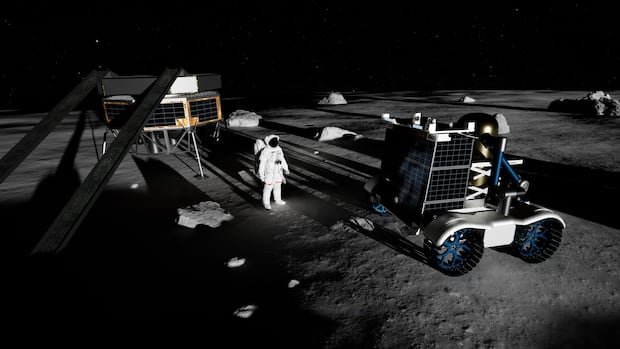
Canada is actively engaging in supporting the mission to return humans to the moon, with Canadian technology already making its mark in space. While the Canadian Space Agency canceled a small lunar rover in March, plans are underway for a larger lunar utility vehicle scheduled for deployment no earlier than 2033. Three Canadian companies, including MDA Space, Canadensys Aerospace, and Mission Control, are competing to secure the final contract for this project.
NASA recently announced a shift from the Lunar Gateway space station to the creation of Moon Base near the lunar south pole, intended as a habitation and work site. The construction of Moon Base will proceed in three phases, with NASA collaborating with commercial partners for the provision of lunar rovers and landers. This accelerated timeline has prompted discussions on advancing the lunar utility vehicle program to meet the evolving needs of the mission.
Canadensys, known for its contributions to lunar exploration, has already deployed several systems on the moon. With an established reputation in space robotics, Canada is recognized as a significant player in lunar operations and technology advancement.
Addressing the critical need for power in sustaining a lunar base, the Canadian Strategic Missions Corporation (CSMC) has been awarded funding by the CSA to develop a low-enriched uranium nuclear reactor for moon applications. This technology, essential for long-term lunar operations, also holds potential for terrestrial use, particularly in remote areas.
As Canada explores opportunities for lunar technology, including mining and robotics, there is a call to leverage the current momentum and build on the success of recent space missions to contribute significantly to future space exploration endeavors.