
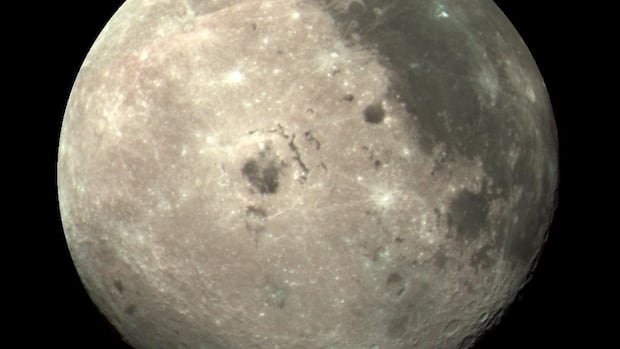

Canadian astronaut Jeremy Hansen will embark on the Artemis 2 mission to explore the far side of the moon, a region unseen from Earth. Meanwhile, scientists plan to deploy telescopes and robots to investigate this area further. Despite being commonly referred to as the “dark side,” the far side of the moon receives equal sunlight as the near side. It boasts a rugged, crater-filled terrain in contrast to the smooth plains of the near side known as “Maria,” which translates to seas in Latin. This unique area is shielded from Earth’s radio interference, making it an attractive location for astronomers to set up radio telescopes.
Hansen’s journey will provide a rare opportunity to witness sights unseen since the Apollo era, as he will travel 7,500 kilometers beyond the moon, offering a panoramic view of the Earth. Unlike Apollo missions that focused on equatorial regions, Hansen will have a broader perspective, observing the entire globe and witnessing Earth and the moon together from a new vantage point.
During the Artemis mission, detailed observations of the lunar surface will be made by the crew to capture subtle details crucial for future landings. These observations, discernible to the human eye, can reveal surface conditions affecting spacecraft landings, such as dust levels and surface roughness.
Future missions, such as the Japanese TSUKUYOMI project, aim to place radio dishes on the far side to study the early universe during the dark ages, a time of neutral hydrogen gas preceding the formation of stars and galaxies. Detecting faint radio signals from this era could shed light on the role of dark matter in shaping the universe’s evolution, leading to the creation of celestial bodies.
Proposed missions like TSUKUYOMI, LuSEE Night, and the Farside Seismic Suite by NASA are set to explore the moon’s far side in the coming years, paving the way for advanced lunar observatories. While human missions focus on colony building and resource exploration, robotic missions on the far side aim to unravel the mysteries of the universe’s origins. This hidden side of the moon will soon host a multitude of robots observing the cosmos, seeking answers to the universe’s fundamental questions.