
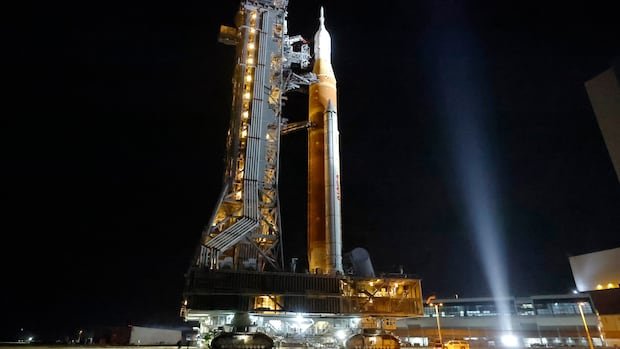

Imagine a family road trip in a minivan, except you’re traveling at 28,000 km/h without any pit stops for almost 10 days. This is what four astronauts, including Jeremy Hansen from the Canadian Space Agency (CSA), will experience as they orbit the moon in the Orion capsule during NASA’s Artemis II lunar mission.
The spacecraft is set to launch from the Kennedy Space Center in Florida soon, following delays due to technical issues during previous attempts. The crew, which includes veteran NASA astronauts Reid Wiseman, Victor Glover, and Christina Koch, has undergone extensive training for the mission.
David Saint-Jacques, deputy director of the CSA’s lunar exploration program, stated that the astronauts will venture further into space than any humans have gone before. This test flight will provide valuable insights for future deep space travel.
The crew will have to adapt to the confined space inside the Orion capsule, which is comparable in size to a minivan or SUV, but with 9.3 cubic meters of space. Sleeping arrangements involve hammock-like sleeping bags, and maintaining daily routines is crucial for their well-being.
Food onboard consists of freeze-dried meals tailored to each astronaut’s preferences, with limited water available for consumption. The waste management system on Orion is basic compared to the ISS, with waste being stored on board for return to Earth.
Physical exercise using a flywheel device will help the astronauts combat muscle and bone density loss in the zero-gravity environment. Mental health support includes access to medications and the camaraderie of the crew members who have trained together extensively.

Ahead of NASA’s Artemis II mission around the moon, The National’s Ian Hanomansing talks to Canadian astronaut Jeremy Hansen about the intensive training required and preparing for the worst-case scenarios.