
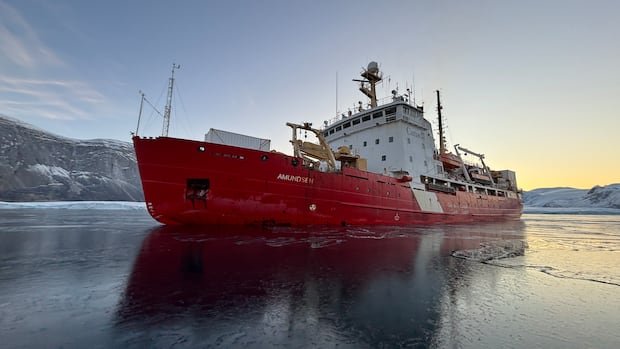

The waters surrounding the Queen Elizabeth Islands and western Tuvaijuittuq in Canada’s High Arctic have remained enigmatic to scientists for a long time. These waters, known as one of the few places globally with year-round sea ice, have been challenging to access due to the thickness of the ice historically. However, the melting sea ice has created an opportunity for a Canadian research icebreaker to navigate through some of these passages for the first time.
David Babb, a research associate at the University of Manitoba’s Centre for Earth Observation Science, noted the changes: “We have lost ice, we have increased the area of open water, and the area is now more navigable.” Scientists from Fisheries and Oceans Canada (DFO) and the University of Manitoba set sail on a four-week expedition aboard the CCGS Amundsen on September 4 to investigate Arctic sea ice. According to DFO, this voyage marks the first comprehensive oceanographic research mission to reach this region of the Canadian Archipelago.
During the expedition, Babb, part of the research team, explained the presence of two types of ice: seasonal ice, which forms over one winter and is thinner, leading to open water, and multi-year ice, which thickens over multiple winters. Babb observed a shift towards more seasonal ice and less multi-year ice in recent times.
Numerous studies indicate that the Arctic is warming at an alarming rate, with some projections suggesting the disappearance of Arctic sea ice within this decade. The ability of an icebreaker to access one of the last strongholds of sea ice globally serves as a stark indicator of the impacts of climate change. It also offers a valuable opportunity for researchers like Babb to study this understudied Arctic region and gain insights into current conditions and future projections.
While onboard the research vessel, Babb expressed surprise at the scarcity of thick ice, fish, and organic matter in the Arctic waters, particularly in areas like Nansen Sound and Greely Fjord. The team encountered deteriorated and heavily melted sea ice, with the thickest ice found measuring around seven meters. Despite the remoteness of this area from nearby Nunavut communities, Babb emphasized the interconnectedness of the High Arctic’s changes with downstream effects on larger fisheries operating further south.
At the conclusion of their expedition in October, the research team engaged with the community at Resolute Bay’s Qarmartalik School to share their findings and knowledge. The exchange provided valuable insights for local students like Kupaaq Idlout, who learned about mercury presence and phytoplankton in the ocean. Community observations and discussions highlighted the evolving ice conditions, with elders noting faster ice melting and changes in traditional travel patterns.
Babb emphasized the importance of involving community members in measuring ice thickness during land excursions, aiming to incorporate their invaluable firsthand observations into future research endeavors. He emphasized the significance of leveraging the unique insights of those who live and interact closely with the Arctic environment.