
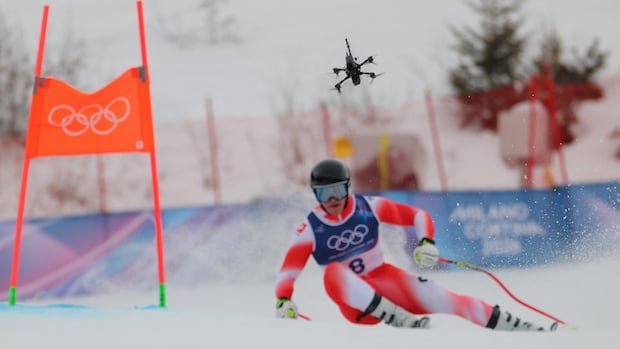

Amidst the freestyle skiing slopestyle competition at the Winter Olympics, Canadian athlete Megan Oldham soared down the slope on her final run, securing an Olympic bronze medal. A notable addition to the event was the presence of a drone following Oldham closely, providing viewers with a unique perspective, thanks to the Olympic Broadcasting Services.
These cutting-edge drones, known as first-person view (FPV) drones, are a recent innovation in Olympic coverage, offering high-speed tracking of athletes with precision matching their movements on the slopes, jumps, and ice. While drones have been utilized in the Olympics since 2014, the introduction of FPV drones marks a significant advancement in capturing the action.
Operated by skilled pilots equipped with headsets and controllers, these drones have garnered attention for their ability to reach speeds of up to 75 km/h to keep up with alpine skiers and navigate the challenging terrain of the luge track. The technical expertise required to operate the drones effectively has been a focal point of discussion at the Games.
Despite the technological marvel, one critique of the drone use has been the noise they generate, often overshadowing other sounds during broadcasts. Athletes have also shared mixed reactions, with some expressing discomfort at the drones’ proximity during their performances. However, many acknowledge the value of the drone footage in enhancing the viewing experience of the Olympics.
According to Pierre Ducrey, the sports director of the International Olympic Committee, while the integration of drones may take some adjustment, they bring a new dimension to the Olympic coverage, providing audiences with a closer look at the athletes’ performances. The evolving use of drones in sports broadcasting represents a significant shift in capturing the intensity and excitement of athletic competition.