
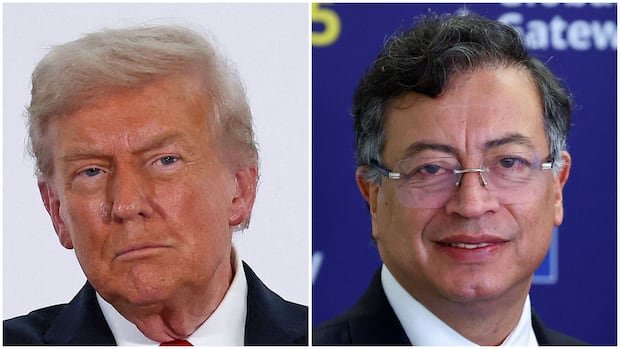

Colombia has taken back its ambassador from the United States following President Donald Trump’s announcement of increased tariffs and cessation of payments to the country over U.S. military actions against drug-carrying vessels. Trump’s labeling of Colombian President Gustavo Petro as an “illegal drug leader” has been met with strong objection from Petro’s government.
The Colombian foreign ministry revealed that Ambassador Daniel Garcia-Pena has been summoned back to Bogota for consultations by President Gustavo Petro. The government is set to disclose further decisions in the coming hours.
Tensions between Washington and Bogota reached a new level as Trump accused Colombia of involvement in the illicit drug trade. Petro has criticized the U.S. military’s strikes on ships in the Caribbean, which the Trump administration claims were necessary to counter imminent threats posed by “narcoterrorists” linked to Venezuelan President Nicolás Maduro.
Critics, including legal experts and human rights activists, have condemned the military operations, questioning their legality as the U.S. portrays the drug traffickers on the vessels as unlawful combatants.
Trump’s decision to slash financial aid to Colombia and introduce new tariffs has created uncertainty, although the specifics of the aid cuts mentioned by Trump remain unclear. Colombia, a significant exporter of commodities such as oil, coal, coffee, flowers, and bananas, faces challenges amid the strained trade relationship with the U.S.
Petro condemned the recent bombing incident that resulted in casualties, refuting claims by U.S. Secretary of Defense Pete Hegseth linking the boat to a rebel group. Petro criticized Trump’s remarks, emphasizing that Colombia has never displayed rudeness toward the U.S.
Efforts by Petro to tackle coca cultivation in Colombia have faced obstacles, with the country struggling to curb drug production. Foreign aid from the U.S. aimed at eradicating illegal coca crops and supporting anti-drug initiatives has faced setbacks due to environmental concerns and legal challenges.
The U.S. has intensified its military presence in the Caribbean but has provided limited details on the recent boat strikes, which have raised concerns among lawmakers and human rights advocates regarding transparency and adherence to legal protocols.
Survivors of the boat strikes have been repatriated to Colombia and Ecuador, prompting calls for accountability and clarity on the legality of the operations. Democratic lawmakers and Republican Sen. Rand Paul have demanded more information on the incidents, questioning the lack of evidence and legal process in the aftermath of the attacks.