

Historical structures, like Alexander Graham Bell’s residence in Nova Scotia, often transform into museums or national historic sites to safeguard their legacy for future generations. But what about preserving a structure the size of a football field circling 400 kilometers above the Earth?
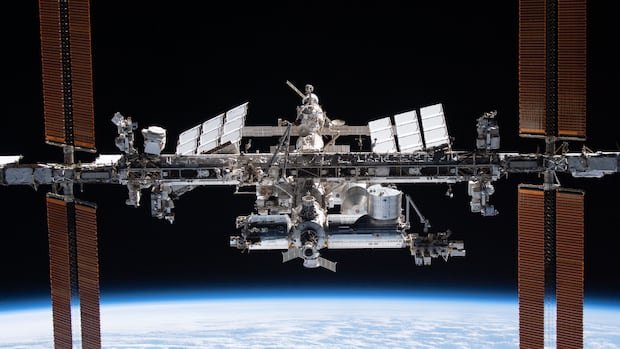
NASA’s official strategy entails deorbiting the International Space Station (ISS) at the conclusion of its lifespan, initiating a controlled reentry where it will plunge back into Earth’s atmosphere and crash in a remote ocean area. However, recent U.S. Government actions have proposed that NASA reassess this approach and explore the possibility of maintaining it in low Earth orbit.
Since 2000, the ISS has hosted numerous astronauts from the U.S., Russia, Canada, Europe, and Japan, serving as a hub for groundbreaking experiments conducted in a microgravity setting. Assembled over time through multiple space missions, the ISS, with a mass exceeding 400 metric tonnes, stands as the most extensive scientific laboratory ever launched into space.
With NASA announcing the decommissioning of the ISS in 2030 and its scheduled deorbit in 2031, discussions have emerged regarding alternative fates for the station. While the current plan involves a controlled reentry over the Pacific Ocean, some advocate for exploring options beyond a fiery demise.
However, preserving the ISS poses complex challenges. The station’s orbit necessitates regular adjustments to counteract atmospheric drag, preventing an uncontrolled descent. Various proposals, such as boosting it to a higher orbit, come with technical and logistical hurdles, including increased collision risks with space debris.
While proposals for repurposing the ISS or transferring ownership to private entities have been considered, no viable options have emerged. As NASA shifts focus towards lunar and Mars missions, the fate of the ISS remains uncertain. With new space stations like China’s Tiangong already operational and plans for commercial space stations in development, the future of orbiting habitats is evolving.
Despite ongoing discussions and proposals to preserve the ISS, the likelihood remains that after three decades of service and a hefty price tag of $100 billion, the fate of the ISS may culminate in a fiery reentry, leaving behind remnants at the ocean floor—unless a more viable solution emerges.