
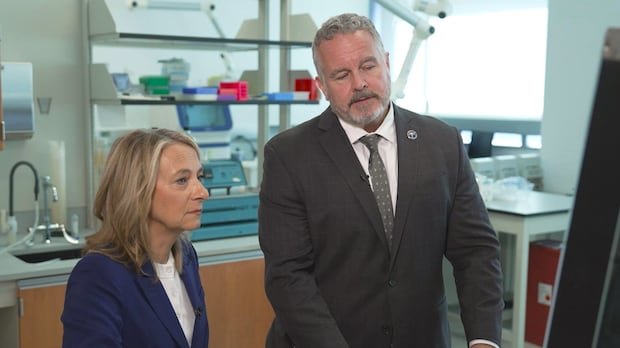

In a laboratory located in Manhattan, forensic experts in white lab attire are actively continuing their commitment made a quarter of a century ago. They are isolating genetic material from numerous human remains retrieved after the tragic events at the World Trade Center, striving to link them with samples from personal belongings provided by the families of the victims. Advances in DNA extraction techniques and forensic investigative methods not available in 2001 have revolutionized their approach.
Mark Desire, the assistant director of forensic biology at the New York City Office of the Chief Medical Examiner, expressed the profound impact of identifying a loved one and reuniting them with their family after years of scientific advancement. Among the 2,753 individuals who perished at Ground Zero, 40% remain unidentified, including about 10 of the 24 Canadian victims. Recently, the lab disclosed its initial identification of previously unidentified remains using an innovative procedure, although the individual’s identity was kept private by the family.
The breakthrough technique merges DNA testing with genetic genealogy, leveraging family tree research conducted by the New York City Police Department. Dr. Jason Graham, the Chief Medical Examiner of New York, hailed this method as a new frontier with the potential for numerous future identifications. The innovative approach has sparked renewed hope for Monica Iken-Murphy, whose husband was a victim of the terrorist attack, as she yearns for closure.
The excruciating process of excavating and preserving remains has been a formidable challenge. Desire, who was a novice scientist at the New York crime lab during the 9/11 tragedy, vividly recalled the chaos and peril he encountered while preserving evidence at Ground Zero. The World Trade Center site, reduced to a massive debris pile, presented immense obstacles due to various contaminants that could compromise DNA preservation. Despite the formal conclusion of excavation work in 2002, ongoing searches and discoveries of bone fragments have continued until recent years.
Advancements in forensic science have enabled the extraction of more DNA from bone fragments, although bone remains the most challenging material for DNA retrieval. The arduous process of testing severely damaged samples multiple times underscores the immense pressure faced by the scientists. The integration of genomic sequencing and genealogical analysis has emerged as a beacon of hope, offering new possibilities for identifying the remaining unknown victims.
The Chief Medical Examiner’s office is urging families to provide DNA samples to enhance the chances of making further matches. However, some families, like Abigail Carter, have found solace in honoring their loved ones in their own ways without the need for physical remains. The complex emotions and decisions faced by the families of victims underscore the enduring impact of the 9/11 tragedy and the ongoing quest for closure and remembrance.