
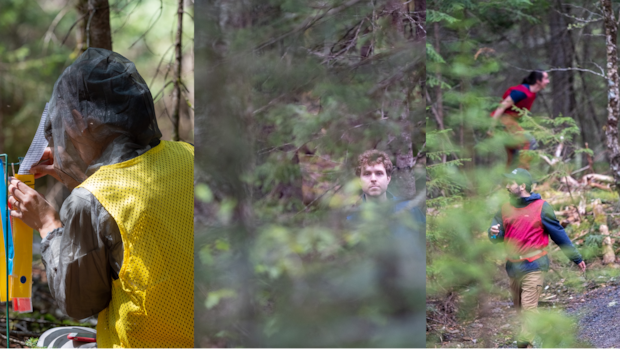

Skulking cautiously through the woods of Quebec, experiencing a rush of adrenaline while foraging for limited resources and evading potential predators is all in a day’s work for ecologist David Bolduc from Université Laval.
To delve deeper into the intricate dynamics between predators and prey in nature, Bolduc, along with his team and numerous international students, converged at Éco-Laurentides park near Val-Morin, Quebec, for a predator-prey role-playing game during a summer session.
The rules were straightforward, as Bolduc explained to As It Happens host Nil Köksal – it was a matter of survival, either living or perishing. The participants engaged in 30-minute simulations akin to a game of tag to observe if human behavior would mirror the predator-prey interactions observed in wildlife.
As per their study findings, published in the open-access journal Methods in Ecology and Evolution, humans exhibit similarities to animals, often employing comparable survival tactics as seen in species like wolves or deer.
While the experiment has been praised by scientists as a creative and engaging means to explore ecosystems, there are constraints to consider. The use of a human-based game may not directly translate to drawing conclusions about wild animal behavior where life-and-death scenarios are real.
The study, conducted in July 2023, involved participants categorized into three groups: prey, constantly hunted but not hunters themselves; mesopredators, medium-sized creatures preying on smaller species; and apex predators, positioned at the top of the food chain.
The prey’s objective was to locate resources scattered in envelopes across the designated play area, “reproduce” by connecting with team members, and evade being captured by predators.
For predators, their task was to capture prey individuals.
Survival in the game equated to having ample food resources and avoiding being captured, constituting a successful outcome, as per Bolduc.
Presented as a novel approach to studying predator-prey interactions, this method offers a more realistic perspective than conventional mathematical models while being less complex than fieldwork, which often lacks real-time predation observation and control over all influencing variables.
By maintaining a consistent group of players and adjusting variables like landscape features or resource distributions, researchers can test hypotheses on how predator-prey dynamics might unfold in varied scenarios. Nonetheless, the need persists to validate any conclusions through observations of actual animals in their natural habitats.
According to Bolduc, using this game as a preliminary step can unveil insights and offer a platform for developing necessary analytical tools before transitioning to field studies.
External scientists not involved in the research expressed admiration for the approach, acknowledging its novelty as an innovative means of studying behavioral interactions in wildlife.
The study noted parallels between human behavior in the game and that of wild animals. For instance, predators preferred well-trodden paths to scout for prey, while prey tended to remain concealed in shadows.
Despite these resemblances, experts like Leblond and Gibert caution that human behavior deviates significantly from that of wild creatures due to individual player biases, competitive tendencies, and relational influences, factors absent in natural ecosystems where risks of mortality are real.
The primary advantage of the game, as highlighted by researchers, lies in its educational value, fostering enriching discussions among players on ecological theories and animal behaviors, presenting a fresh and engaging approach to learning about ecological concepts.