
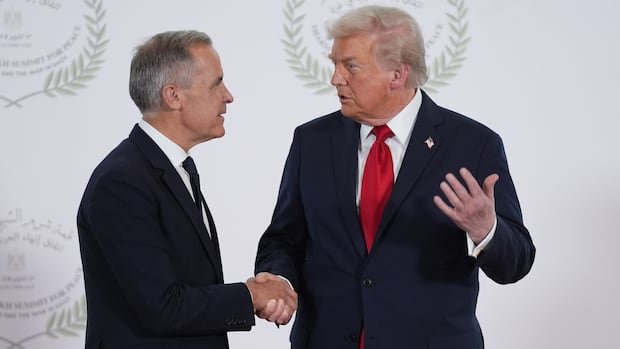

The upcoming review of the Canada-U.S.-Mexico Agreement (CUSMA) trade deal is gaining momentum as U.S. President Donald Trump continues his efforts to reshape global trade dynamics and attract key industries away from the United States’ neighboring countries. Negotiations surrounding CUSMA, formerly known as NAFTA, posed a challenge for Ottawa during Trump’s initial term, with tensions at times; however, the resulting agreement was deemed a success across all participating nations.
Following Trump’s reelection, doubts have arisen regarding the future of CUSMA. During a meeting with Canadian Prime Minister Mark Carney at the White House, Trump referred to the deal as “transitional,” hinting that its purpose might have been fulfilled. According to Fen Osler Hampson, an international affairs professor at Carleton University in Ottawa, trade with Canada might not be a top priority for Trump, as it represents a concealed yet crucial aspect of a deeply interconnected economic relationship.
The review process for CUSMA commenced in the U.S. with public consultations in September. The Trump administration is anticipated to present a report to Congress early next year outlining proposed changes. The formal review is set to begin in July, with Canada-U.S. Trade Minister Dominic LeBlanc scheduled to initiate discussions with American counterparts in January.
Regarding the future of CUSMA, the three countries involved face a choice between renewing the agreement for another 16 years, withdrawing from it, or indicating non-renewal and non-withdrawal, which triggers an annual review mechanism. While Trump has expressed interest in extended negotiations, he has also hinted at the possibility of letting CUSMA expire.
The renegotiation process is expected to resemble the original talks, with concerns from all sides to be addressed through negotiations. Trump has highlighted various trade issues with Canada, such as dairy supply management, lumber sector subsidies, and non-tariff barriers, which are likely to be discussed during the upcoming negotiations. Additionally, the U.S. Trade Representative has raised concerns about the impact of Canadian regulations on U.S. digital services firms.
The automotive industry, with its revised content and labor requirements under CUSMA, is another focal point for negotiation, especially with the disruption caused by Trump’s tariffs. Canada holds leverage in critical minerals and energy supply, which align with the U.S.’s strategic interests in reducing reliance on China for critical minerals.
As the CUSMA talks unfold, the U.S. Supreme Court’s ruling on Trump’s tariff imposition authority will significantly impact the negotiation landscape. The negotiations will coincide with a tense midterm battle in Congress, potentially complicating the trade agreement’s revision process.
In conclusion, as the renegotiation of CUSMA approaches, both the U.S. and Canada are positioning themselves strategically, with uncertainties surrounding the outcomes and potential shifts in trade dynamics in the near future.