
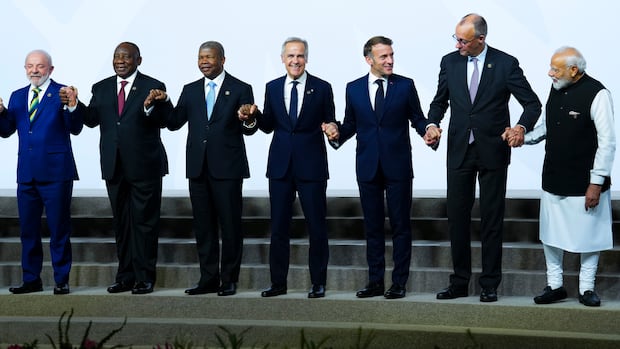

During this year’s G20 summit in South Africa, leaders expressed deep concerns regarding the group’s relevance and effectiveness due to rising geopolitical tensions and significant transformations in the global order.
Established in the late 1990s, partly through the efforts of former Prime Minister Paul Martin, the Group of 20 has convened annually since 2008, concentrating on international economic and financial stability.
It is intended to represent the peak of multilateralism: the concept that countries can collaborate, negotiate, and coordinate for the collective benefit.
However, the landscape has changed considerably over the last twenty years.
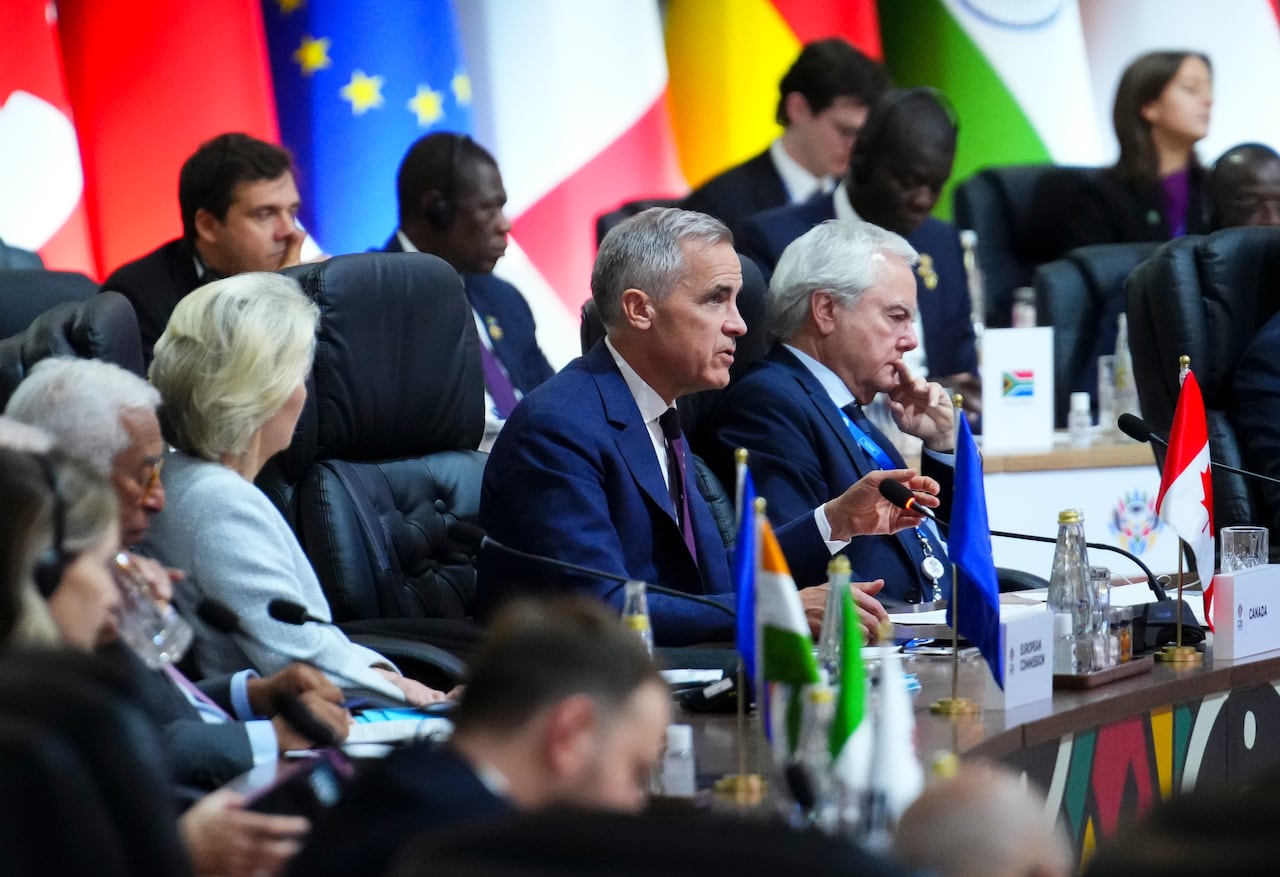
Carney noted that as the global economy evolves, new opportunities will arise for countries like Canada. (Sean Kilpatrick/The Canadian Press)
French President Emmanuel Macron remarked at the summit’s opening, “We are facing challenges in resolving significant crises collectively at this table,” further stating that “the G20 may be nearing the end of its cycle.”
Central to this “rupture” in the global order, as described by Prime Minister Mark Carney, is the United States and its President Donald Trump.
Trump’s trade wars affecting most countries, along with his transactional stance on geopolitical issues like the conflict in Ukraine, caused G20 members to prioritize economic security over integration.
Even China, a major economy frequently criticized for undermining global security, expressed its apprehensions about future developments.
-
Analysis
3 ways Canada and China can reset their relations in Trump’s new trade world
-
Carney signs onto AI and technology partnership with India and Australia
“Unilateralism and protectionism are widespread,” stated Chinese Premier Li Qiang, who represented President Xi Jinping at the G20.
“Many are questioning what is happening to global unity.”
President of Finland Alexander Stubb, attending the G20 for the first time, expressed his concerns regarding the future of multilateralism.
“It’s increasingly about individual deals, making it more susceptible to conflicts,” Stubb remarked during his opening address.
A G20 without the U.S.
Trump’s complete absence—no American representatives were sent in his stead—has raised questions about broader global unity. However, it also reinforced solidarity among the remaining participants.
Foreign Affairs Minister Anita Anand highlighted the consensus declaration adopted at the summit’s outset.
“One of the strengths of the G20 is the formal and informal discussions and decisions made among leaders,” she noted.
“Considering it’s the inaugural G20 held in Africa and includes not only G20 members but also outreach partners, it marks a significant day for multilateralism.”
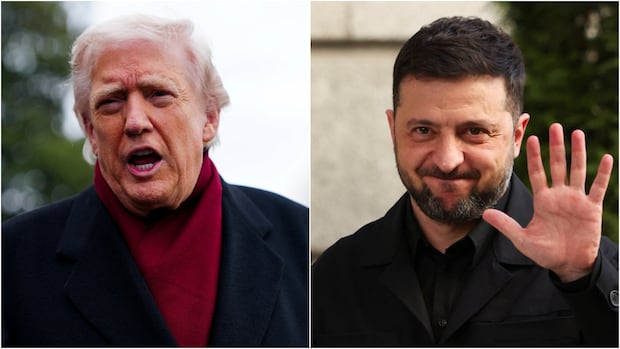
Many of Ukraine’s allies have expressed concerns that U.S. President Donald Trump’s peace plan amounts to a ‘wish list’ for Russia. But Christian Leuprecht, a professor at the Royal Military College and Queen’s University, says Ukraine is in a weak position and that Trump’s deal presents a ‘significant opportunity’ for both sides to find common ground in a way that meets everyone’s ‘reasonable objectives.’
A coalition of nations, including Canada, the U.K., Japan, France, Germany, and the EU, convened on the sidelines of the summit to address what Ukrainian President Volodymyr Zelenskyy described as one of the most challenging periods in his nation’s history.
Trump has set a deadline for Ukraine to accept his proposal to conclude the conflict—a plan perceived as heavily favoring Russia.
The response from the coalition was a carefully crafted statement that “welcomed” U.S. peace initiatives while asserting that many aspects of the draft require “further development.” It emphasized that borders should not be altered through force and raised alarms over the suggested reduction of Ukraine’s military forces.
The “coalition of the willing” will meet on Tuesday to discuss the plan, with U.K. Prime Minister Keir Starmer noting there has been “progress” in incorporating elements that are more acceptable to Ukraine.
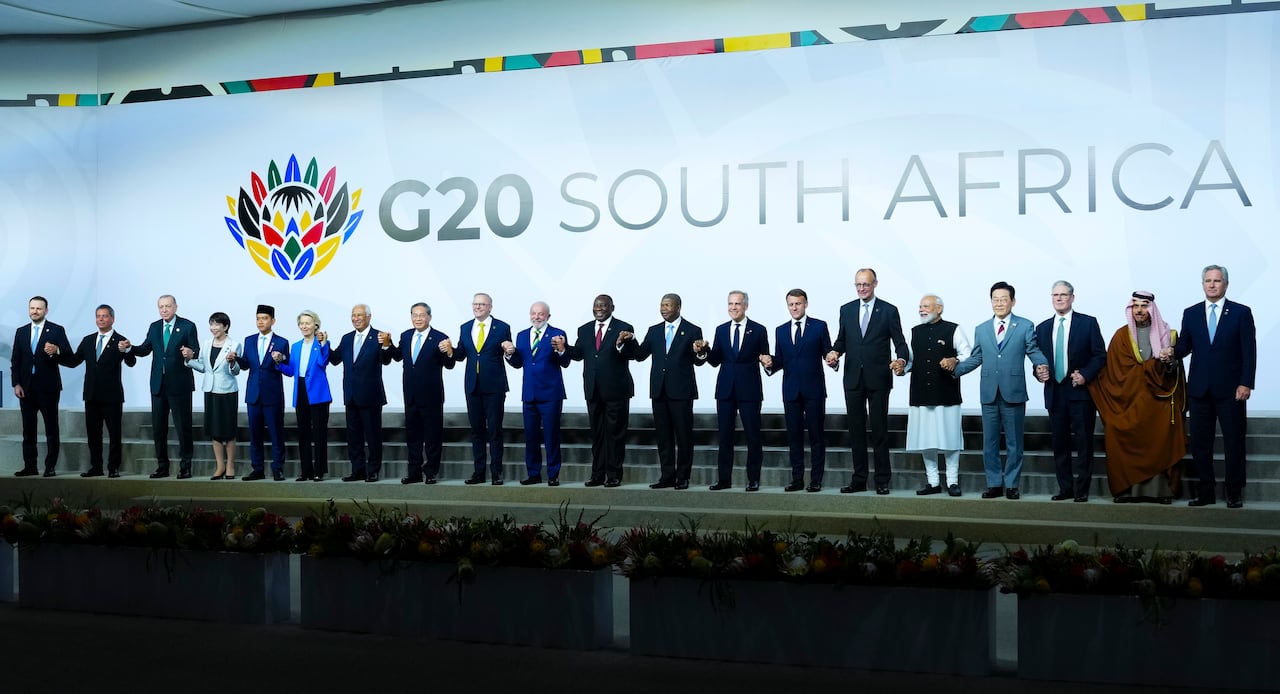
Default Caption: Prime Minister Mark Carney joins fellow G20 leaders for a family photo on Saturday. (Sean Kilpatrick/The Canadian Press)
The U.S.’s move towards isolationism and its commitment to an “America First” strategy has prompted countries, particularly middle powers like Canada, to seek out and establish alliances with like-minded nations to enhance trade, investment, and security.
Carney emphasized that the countries participating in the summit accounted for two-thirds of global GDP and three-quarters of international trade.
“We are not undergoing a transition, but rather a rupture. With each rupture, we bear the responsibility to forge a new beginning. Nostalgia is not a viable strategy. We are not reconstructing the past; we are creating something improved,” he stated in French during his closing press conference.
For Carney—and, by extension, Canada—this “something improved” translates into an expanding array of investment agreements and trade discussions with various nations.
His office reports a secured $90 billion investment in Canada’s economy from the U.A.E., with $23 billion allocated for specific initiatives. Carney also initiated discussions aimed at establishing a new investment pact with South Africa and revealed the commencement of negotiations for a trade agreement with India.
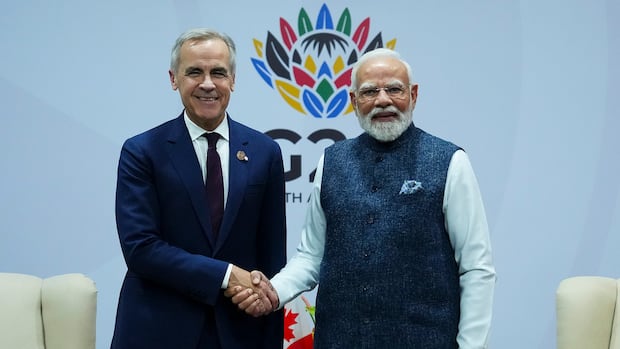
Prime Minister Mark Carney utilized the G20 meeting to broaden Canada’s trade relationships, including an agreement to pursue a new trade deal with India following a period of tensions between the two nations.
Carney engaged in discussions with European Commission President Ursula von der Leyen and Vietnam Prime Minister Phạm Minh Chính, aiming to establish connections between the Pacific Rim and EU regions.
“Connecting these two major trading blocs, which encompass over a billion individuals, will enhance trade, stimulate investment, and foster partnerships across various sectors from AI to energy in the Indopacific, Europe, and certainly in Canada,” Carney noted.
He indicated that senior officials from all parties will collaborate in the coming months to achieve “tangible outcomes in this new bloc.”
-
Carney, Modi agree to launch negotiations on new Canada-India trade deal
-
Canada joins world leaders saying Trump’s plan to end war in Ukraine needs ‘additional work’
-
Carney attends G20 summit with aim to boost trade — and as Canada cuts foreign aid
Over the years, the number of invitees and the scope of the G20’s objectives have significantly increased. The U.S. will assume the presidency next, and with Trump in charge, a reduction in both attendees and agenda priorities is anticipated.
However, with the U.K. and South Korea hosting the summits in 2027 and 2028, the immediate future of the G20 appears secure.
Proponents of global cooperation argue that multilateralism is not obsolete—it is merely undergoing transformation.
Carney believes the global economy, characterized by a “concentration of capital, production, and power,” is being reshaped by a “diffusion of energy and influence” in the upcoming century.
In this context, he stated that new roles will emerge for middle powers like Canada within “multilateral frameworks that benefit all.”