
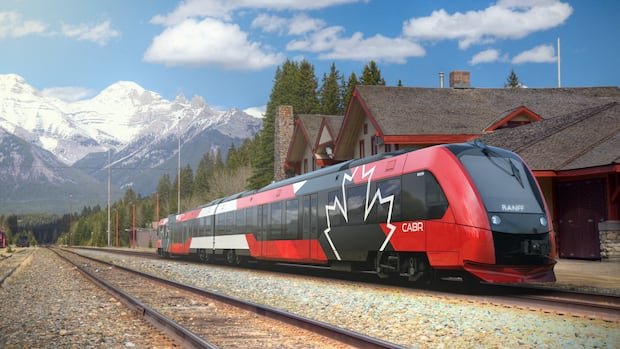

A plan has been put forward to the federal government for a hydrogen-fueled passenger railway connecting Calgary and Banff in hopes of expediting the process. Liricon Capital and Plenary Americas are set to fund the line linking the city to the mountain town, contingent on the provincial government financing a rail connection from Calgary International Airport to downtown.
Calgary Mayor Jeromy Farkas emphasized the significance of the project, stating that it presents both a crucial economic development opportunity and a practical advantage for daily commuters. He highlighted that the rail service would not only cater to tourists exploring Calgary and the mountains but also benefit local commuters heading to work or the airport.
The federal government’s Major Projects Office, responsible for expediting nationally significant projects, refrained from commenting on the railway proposal. Farkas mentioned that the proposed rail line would also serve other communities in southern Alberta, with planned stops in Cochrane, Mînî Thnî, and Canmore.
Joe Pavelka, an ecotourism and outdoor leadership professor at Mount Royal University, outlined various potential benefits of the rail system, including addressing Banff’s traffic concerns and improving management of visitors in the Bow Valley area.
The anticipated ridership for the rail service is expected to comprise mainly commuters and airport travelers, rather than tourists. Pavelka suggested that easy access to Banff without a car could enhance Calgary’s competitiveness in hosting conferences and conventions.
According to Paul Martin of Plenary Americas, the project’s primary obstacle lies in securing provincial support. If the province commits in a timely manner, construction could commence in 2028, with passenger operations starting by 2030.
The proposal has been under development for several years, with the previous provincial government, led by Jason Kenney, declining to allocate funds for the project. Provincial Transportation Minister Devin Dreeshen emphasized the need for consultations with municipalities and First Nations, as well as an evaluation of the project’s alignment with the province’s passenger rail strategy before committing to the initiative.
Jan Waterous, managing partner at Liricon, expressed optimism that approval from the Major Projects Office could expedite provincial endorsement of the project, demonstrating seriousness and feasibility. The launch of the Major Projects Office in August, spearheaded by Prime Minister Mark Carney, has identified 11 projects for fast-tracking, none of which are located in Alberta.