
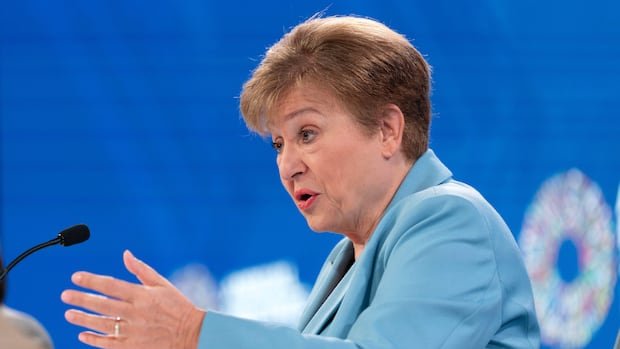

The International Monetary Fund (IMF) chief has praised Canada’s fiscal standing compared to other G7 countries, despite the Liberal government planning for a higher deficit this year. IMF Managing Director Kristalina Georgieva commended Germany and Canada for being in favorable fiscal positions during a press briefing at the IMF’s annual meeting in Washington. Georgieva recommended that Canada utilize its fiscal flexibility to stimulate growth, particularly in key sectors like housing, infrastructure, and energy to enhance productivity.
The IMF recently projected a global growth slowdown over the coming years due to factors such as prolonged uncertainty, protectionism, and potential financial market corrections. Canada, impacted by U.S. President Donald Trump’s tariffs, is expected to experience a growth rate decrease to 1.2% this year. The Liberal government, led by Prime Minister Mark Carney, who took office in April, plans to introduce its budget on November 4, focusing on nation-building initiatives to counter the effects of tariffs and meet NATO defense spending targets.
Furthermore, the Parliamentary Budget Officer (PBO) forecasted a larger deficit for Canada this year, with interim PBO Jason Jacques expressing concerns about the country’s financial state. Former PBO Kevin Page disputed Jacques’s negative assessment, stating that Canada’s fiscal situation is relatively stable compared to other G7 nations. Page emphasized that the deficit increase is manageable given the economic slowdown and NATO commitments.
In response to the government’s budgetary changes, including shifting all future budgets to the fall and separating operational and capital expenditures, the IMF’s Georgieva welcomed the adjustments as positive steps. The new budgetary framework aims to enhance transparency and fiscal planning, aligning with IMF recommendations for prudent fiscal management.